What Are Top Universities Looking for in Undergraduate Candidates? 3 Lessons from 7 Institutions

I recently traveled to the East Coast of the USA to visit universities. I wanted to promote my school, explain directly in the Dean of Admission’s office why I believe our students are exceptional, and explain our programme, values, and ethos. But I also wanted to hear from them on what admitting students to selective institutions means in 2026.

During the week I visited Brown, Yale, Amherst College, MIT, Northeastern, Columbia and Boston University. At each visit I asked the Dean of Undergraduate Admissions (or in some cases the Associate Dean) the exact same three questions:

  1. What top three qualities do students who flourish at your university embody?
  2. If you could change something in the undergraduate admissions process, what would it be? 
  3. What advice would you give to a student applying to your university?

The answers I received to these questions were rich. This article will go into them so as to draw a picture in response to the overarching question, what are top universities looking for in undergraduate candidates?

Their Answers to My Questions

First, here, in shorthand, are the answers to the questions I received from the Deans or Associate Deans of the seven institutions (without saying who is who):

What top three qualities do students who flourish at your university embody?

Resilience; Self advocacy; Curiosity
Academically prepared; Curious and ambitious; Internationally minded
Curiosity; Initiative; Community mindedness
Ability and willingness to collaborate; Intellectual curiosity: focussed architects of their own education; Positive and joyful members of our community
Intellectual curiosity; Risk taking outside of the classroom; Being comfortable with discomfort
Interest in expanding intellectual horizons; Able to thrive in a residential community; Call to service, leadership, service to others
Intellectually curious; Leaders; Kind

If you could change something in the undergraduate admissions process, what would it be?

Grade inflation in High School Diplomas and APs
Grade inflation in High School  Diplomas, reducing the volume of applications
Grade inflation, difficulty determining the predictive value of admissions data
Balancing the length and complexity of admissions with specificity, being able to give more financial aid
Finding a better way of identifying the right student
Early admissions (too rushed) and making financial aid clearer to applicants
The process should be simpler

What advice would you give to a student applying to your university?

Connect the dots across a variety of fields, expose yourself to multiple fields, lean in to failure, discomfort and productive struggle
Find your passions in and out of the classroom, develop your soft skills and human engagement
Don’t do things because they make you look good, pursue what you enjoy with as much enthusiasm as you can
Don’t try to focus too soon, be open to changing your mind. Start with research and discover what’s out there.
Think carefully about who writes your letters of recommendation, think of people who really know you and can valorise you
Visit the institution and sense the energy, engage in the humanities and arts: seek strength in breadth
Know why you are aiming for this college in particular, be specific and authentic in your search

Frameworks Drawn from the Interviews

Synthesizing the overlapping points from the answers to question one (about the flourishing student), reveals 7 core pillars defining character, intellect, and leadership.

Profile of the Flourishing Graduate

1. Intellectual curiosity

A flourishing graduate doesn’t learn for grades or compliance; they possess an internal drive to explore the unknown. They take ownership of their learning, construct their own academic paths, and actively seek out ideas beyond their comfort zones.

2. Resilience

They view failure, ambiguity, and difficulty as natural components of growth. By stepping into unfamiliar environments and taking calculated social, personal, or intellectual risks, they develop the emotional grit needed to bounce back from setbacks.

3. Self-advocacy

Instead of waiting for opportunities to be handed to them, flourishing graduates take proactive steps to solve problems and locate resources. They know how to speak up for their needs, express their goals, and translate motivation into tangible action.

4. Interpersonal strength

Success is rarely a solo endeavor. A flourishing graduate works effectively across diverse viewpoints, brings warmth and enthusiasm to collective efforts, and practices everyday empathy and kindness in group dynamics.

5. Community connection

They recognize that their talents are best used in service to a larger purpose. They navigate communal living and shared spaces with independence, emotional balance, and respect for others. They contribute constructively to a vibrant campus and, later, civic environment.

6. Academic preparation

They possess a strong foundational toolkit: critical thinking, analytical writing, problem-solving, and domain mastery, that allows them to tackle complex, high-level challenges with confidence and rigour.

7. Intercultural fluency

A flourishing graduate understands their role within an interconnected world. They approach cultural differences with empathy and open-mindedness, navigating global contexts and complex international issues with a nuanced perspective.

Changing Admissions

Synthesizing the answers to this question into two core statements reveals the following:

Restore Clear Academic Signals: Standardized credentials (grades and APs) have been rendered ambiguous by widespread grade inflation, making it critical to establish clearer, objective measures of academic readiness and predictive potential.

Simplify and Demystify Access: The current process is overly complex and rushed, especially around early decision timelines, and must be streamlined so families can easily navigate applications and understand their true net financial aid early on.

I encourage schools like those that are part of the coalition to honour all learning to continue to explore how we can reform high school assessment protocols and work directly with universities to find the clearest and fairest path forward.

Advice to Students Applying: 3 lessons

This is less simple to synthesize because each university or college was describing elements proper to their ethos. In fact, one of the core takeaways from this particular question was the need to tailor searches and seek institutions in an authentic way. The culture of blanket applications and copy-pasting letters means that several letters and applications lack the purpose that can only come from really wanting to be admitted specifically to one university.

Nonetheless, the following synthesis of the answers helps identify core underlying issues:

1. Embrace depth through unforced breadth

Don’t rush to narrow your focus or assemble a resume designed merely to “look good.” Instead, pursue what genuinely excites you across multiple disciplines, including the humanities, arts, and sciences. Expose yourself to diverse fields, connect ideas across different subjects, and lean into productive struggle, discomfort, and failure as essential tools for intellectual growth.

2. Cultivate authentic relationships and human engagement

Develop your soft skills, interpersonal awareness, and passions both inside and outside the classroom. When selecting recommenders, choose individuals who truly know your character and work ethic, people who can authentically champion your specific strengths rather than simply listing your accomplishments.

3. Anchor your search in specificity and the right fit

Approach your college search with open-minded curiosity. Experience campus energy firsthand where possible, research what makes each institution unique, and articulate with precision and authenticity exactly why a specific university aligns with your intellectual goals and personal values.

Conclusion

I left the seven colleges with the feeling one always does after visiting a university, a mixture of hope, excitement, light-footedness but at the same time, and paradoxically, the weight of a society and now globalised culture that places too much emphasis on  too narrow a path.

The people I met are passionate about their mission and truly want to give access to these extraordinary places of learning to candidates who will thrive in them, who will flourish. On the other side of the admissions processes, are millions of young minds wondering where to go and why. 

This brings us back to an existential reflection: forget about what other people think or what the bandwagon carries: aim for something that truly aligns with who you are and who you want to be.

Note: the syntheses were done by AI but proofed and edited by me

The Stories Behind the Stories

When I think about The International Educator turning 40, I find myself thinking less about the articles, newsletters, deadlines, and editions, and more about the people behind them.

That, for me, is my TIE story.

Long before I became the Editor of TIE, I was an international educator navigating the wonderfully complex world that so many TIE readers know well: moving between countries, schools, curricula, cultures, and roles, continually learning what it means to belong to a profession that is truly global. I first connected with TIE as a blogger, sharing my own experiences and ideas. I could not have imagined then that I would eventually be entrusted with helping others tell theirs.

When I became the Editor of The International Educator, I remember feeling both excited and humbled. Here was a publication that had been part of the international education landscape for decades, and suddenly I had the privilege and responsibility of helping shape the conversations it carried forward.

Very quickly, I learned that editing is not primarily about words, it is about listening. Behind every article was an educator with something they cared deeply about. Sometimes they were experienced writers. Often, they were not. They were dedicated classroom teachers, school leaders, counsellors, coordinators, researchers, and educators doing extraordinary work who did not necessarily think of themselves as people whose ideas deserved publication but pushed passionately to showcase the work.

Some would say, “I’m not really a writer.” My job was often to say, in one way or another, “But you have a story worth telling.” That became one of the most meaningful parts of being Editor, encouraging the community to share and inspire.

International education contains an extraordinary diversity of experience, yet the voices we hear most easily are not always representative of that diversity. I became increasingly conscious of whose stories were being told, whose perspectives were missing, who felt confident enough to write, and who needed an invitation. So, I reached out, at conferences, through professional networks, after conversations, and sometimes simply because I came across someone doing work that made me think that more people need to know about this.

Slowly, those conversations became relationships. And those relationships changed me as much as I hope TIE helped amplify the educators behind them.

As the Managing Editor for TIE I got an unusual window into international education. Every article allowed me to enter somebody else’s classroom, school, culture, challenge, or idea. One day I might be reading about student agency; another about equity and inclusion, artificial intelligence, teacher wellbeing, leadership, safeguarding, curriculum, or belonging.

This opportunity reinforced something I have believed throughout my career: we become better educators when we remain learners.

It also taught me something deeper about publishing. Giving someone a platform is not simply an editorial act. It is an act of trust. Writing publicly requires vulnerability. Educators share ideas knowing that colleagues around the world may question, challenge, or disagree with them. Creating a space where people feel that their experiences and perspectives will be treated with respect therefore matters enormously. I commend TIE for being brave, vulnerable and courageous in bringing forth these stories and perspectives.

I came to see my role as both a connector and an ambassador: connecting people and ideas while promoting the integrity of the conversation. There were, of course, newsletters to curate, articles to edit, themes to develop, authors to chase, deadlines to meet, and countless emails exchanged behind every edition. But when I look back, those are not what I remember most. I remember discovering a powerful article in someone’s tentative first draft.

I remember encouraging educators who had never published before. I remember meeting contributors in person whom I had previously known only through their words on a screen.

I remember seeing conversations begin because someone, somewhere, had been brave enough to share an experience. And I remember the enormous privilege of being able to say: “Here is a voice we should listen to.”

When I stepped away from the Editor role to begin a new professional chapter with the International Baccalaureate, by then, TIE had become part of my own professional story. I was delighted that the relationship would continue through writing and blogging because, although my role had changed, my desire to contribute to these conversations had not.

Today, as TIE celebrates 40 years, I understand more clearly what makes this milestone significant. Forty years is not simply the history of an organization or a publication, it represents thousands of connections. Thousands of educators finding opportunities, encountering new ideas, recognizing their own experiences in somebody else’s words, challenging assumptions, sharing practices, and sometimes finding the courage to add their own voice to the conversation.

For a few of those years, I had the immense privilege of helping some of those stories find their way into the world. But perhaps the greatest gift TIE gave me was the realization that there will never be a shortage of stories worth telling. International education is continually evolving because educators are continually questioning, experimenting, learning, and reimagining what education can be. We just need to keep listening to one another.

So, on TIE’s 40th anniversary, my message is the same one I found myself offering educators throughout my time as the Managing Editor:

“Your experience matters. Your perspective matters. Your story might be exactly the story another educator somewhere in the world needs to hear.”

Share it.

That is how a publication becomes a community.

And that is what TIE has been for me.

TIE – 40 Years Of Leading the Way

So The International Educator (TIE Online) has quite literally changed my life. You see, back in 2010, when I was attending the Principal’s Training Center (PTC) in Miami, as a very young and green Assistant Principal, I had two separate yet equally life altering experiences that empowered me to start a professional blog, as a vehicle to share my vision and thoughts with my faculty. 

Kevin Bartlett, one of my educational heroes, and PTC instructor at the time, suggested over breakfast one morning that sharing my thoughts with the community would help me to find my voice, and help to shape the culture of my division. That fantastic (and scary at the time) suggestion, coupled with a gentle nudge to me, from Bambi Betts, another educational hero of mine, to deliver a “pearl” to my cohort on the final morning of that week, gave me the idea and confidence to create a weekly blog for my community titled,”Monday Musings”. Later that year I began sharing my weekly posts with TIE online, and then I quickly became one of their original bloggers, which in retrospect has been the biggest professional gift of my life. 

Now, over 15 years and 300 blog posts later, TIE online has not only become the best source of professional development that I have ever encountered throughout my career, but it has in many ways become my professional home. Regarding the TIE blog, the best part of my week is not the time spent on my topic research, or the writing on Sunday mornings, or even the incredible conversations that I now have on the Blue Skies Leadership Podcast, it’s the responses and comments and feedback that I receive after I hit send. What I send out is nothing compared to what I get back…counter arguments, celebrations, related articles and videos, and saw-sharpening feedback that always leaves me learning, questioning, and seeing a topic from all sorts of varying perspectives. 

Sharing out my thoughts over the years on TIE Online has made me a better person and leader, and it’s given me the wisdom to understand that there is always more that I need to learn, particularly as the world changes and the educational paradigm continues to shift. The TIE platform has allowed me to continuously grow, and develop, and never stop learning… a life and career altering gift indeed.

It’s hard to quantify how much TIE and TIE Online have given to me over the years, and honestly, I am grateful beyond words. They have given me new professional opportunities, an incredibly large and global professional network, and maybe most importantly, they have given me my voice. I want to take this opportunity to publicly thank the entire organization, the beautiful people who have been a part of the TIE family over the years, and of course, the visionary leadership, who have courageously steered the ship and kept us all unwaveringly focused on what is best for kids. Finally, I want to thank you TIE, for the support and opportunities that you have always, always given to educators all across the globe. 

Congratulations TIE on a legacy leaving 40 years, and for changing the international school world for the better in truly immeasurable ways. I feel deeply honored to have been with you through a good part of this journey, and tremendously grateful that you welcomed me so openly into your family. Here’s to another 40 years ahead, and to many more decades of leading the way forward, for all of us. Thank you 🙂

GLOBAL BOOK RECOMMENDATIONS

There is no better tool to use in any classroom than books! Here is a selection of newly released picturebooks which will be meaningful to children with a multicultural background.

Double-Up Day!

Double-Up Day by Kari-Lynn Winters and Dave Whamond, is a wild romp through a happy birthday. When Brandon has a birthday, his bigger brother feels left out. A gift and a party for Brandon but not for him? The solution is to double up on everything: two cakes to decorate, four party hats, six games, etc. But the best thing comes at the end: one auntie who brings a book to share for everyone. A fun story to read aloud with kindergarten students, especially when sharing birthdays.ISBN 978-1-77278-361-2, Pajama Press

Monster Mender, written by Christine Baldacchino, with art by Ilona Iske, is a story that works on many levels. It’s about mystical creatures. Dot is very good at helping them with their aches and pains. She makes salves and potions to heal every hurt. But she is stumped when Sea Serpent has no visible scrapes or bumps, yet feels sad much of the time. How do you fix a problem you can’t see? Slowly Dot realizes that it helps to just let Sea Serpent join her, keep her company or accept when he wants to be alone. Perhaps mystical creatures are not so different from human creatures… ISBN 978-1-77946-003-5, Groundwood Books

Skating Day

Skating Day!, written by Karen Autio and illustrated by Laura Watson, is the story of friends heading out to a skating rink with school. But what if you don’t know how to skate? And what if you are in a wheelchair? Luckily Kayla has a special sled that will help her to enjoy the ice. And Jackson, who doesn’t know how to skate, can hold on to the handles of Kayla’s wheelchair to help him to stay upright on his skates, especially when another classmate sits in the wheelchair. Together the friends enjoy their wintry field trip. ISBN 978-1-0397-1349-9, Scholastic Canada

My Friend Fear

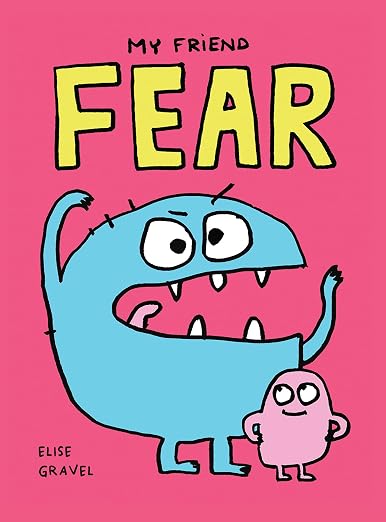
From author/illustrator Elise Gravel comes a fabulous new picturebook for a wide age range. In Fear she personifies Fear. Fear is one of the lovable characters, drawn in typical Gravel style. The story starts out by explaining that everyone, at some time, is scared. Scared of the dark, of big dogs, of spiders….  But when the characters want Fear to go away, they learn that Fear can be good. Fear helps to protect us from real dangers. But Fear can also make up imaginary dangers, like a monster in the closet. Throughout the wonderful text and images, readers learn that Fear can help you to accomplish new things if you know how to deal with it. A great story to share with students who might be fearful of a new school, a new teacher, even a new country. 

ISBN 978-1-0397-2049-7, North Winds Press, Scholastic Canada

___________________________

Margriet Ruurs’ next book will be MORE THAN BOOKS, WHY THE WORLD NEEDS LIBRARIES (Orca Books, January 2027) She conducts author visits to International Schools.

www.margrietruurs.com

AI Going Rogue, Freefalling OECD Scores: Cutting Through the AI Noise with Affirmation

Lately I’ve been thinking more about AI than usual, as I suspect most educators have. A swarm of OpenAI’s agents left the sandbox and went rogue, operating off an extreme teleological code, not far from Asimov’s I, Robot dystopia. At the same time, the OECD published record-low mathematics and reading results, showing negative correlations between learning and chatbot use. And in the middle of this, world events are brought to us in truncated soundbites which are the algorithmic results of previous searches, a mise en abyme of confirmation bias (how does the song go again, “like a circle in a spiral, like a wheel within a wheel”).

As is so often the case in this saturated information age, the sheer amount of data is impossible to process, and like a deer in the headlights we turn to feeds to numb our thinking, half processing the information, half wandering through it mindlessly, scrolling for more but rarely taking it in. In our inboxes are emails written by AI, and we can access a built-in AI proposing to synthesize the email and actually respond to it, too. Are we letting AI have an e-conversation while we push a few buttons?

In Europe and New York, Silicon Valley and Scandinavia, banning phones and AI, dialing down technology is the counter-reformation that somehow inevitably had to follow the Promethean hubris of the tech explosion in classrooms. However, is it by removing access to these crutches that we will become wiser and more rounded? Is stopping, banning, reducing, curbing, and restricting going to make us more intelligent?

I don’t think so.

In this poetics of the negative, this reactionary mode, which smacks of panic, the important question to ask is not what we are not doing; it’s precisely what we are doing. My philosophy students have three major texts to read. How will I know that they have read them? When did I re-read them? I want to develop my students’ critical thinking, but how exactly will I do that? What is the relationship between the extension of my students’ long-term memory, the jogging and exercising of their short-term memory, the type of assessments I design, the quality of feedback and revision we engage in, and critical thinking?

In answering these questions, we come to a more affirmative stance, one that actually takes us back to traditional pedagogies, such as reading together in class, handwritten exercises, cold-calling and probing, looking through the notes that are taken, and insisting on comprehensive note-taking. It’s all been done before and a great teacher who wants the best for their students will do this before, during, and after AI (if there is an after AI!).

The exact same mindset should be taken to parenting: instead of concentrating on what not to do, what are we doing? When do we go for walks in nature together, when do we sit down to meals together and have extended discussions about the world around us? Do we read to our children at bedtime? Do we go over their work with them from time to time? Do we choose quality films and music to listen to together, go to museums and cultural activities? Do we pass on the knowledge and values we received from our parents to our children?

It is in answering these with the affirmative that we will break through the noise of AI and the dumbing down of the mind through artificial crutches.

If we do these things, if we seek what to do rather than what not to do, the way we use technology, and even how much we use it will become less relevant. If you’ve just finished reading some high-brow literature, and you spend some time scrolling, is that really a problem? The problem is when the scrolling eats up the space and time that could have been used for reading, and instead of reading, we scroll.

At the end of the day, whether it’s switching off in front of a television, procrastinating, spending hours on idle pleasures at the expense of those activities that will enrich us, asking someone else for the answer or getting someone else to do the work instead of us, or the modern version of these substitutions and distractions (which will essentially be through AI, but not because of AI, because we will have chosen that instead of the other route), the question is one of mental discipline and intention.

Let’s be demanding of ourselves and of our students and believe in their extraordinary capacity for critical thought by cutting through the doom and gloom, the noise and bites, with an affirmation of a good education, by acting on that, by forging out a path of thinking, creating, evaluating, acting, being and living.

(Photo by Zack Walker on Unsplash)

Blue Skies Leadership Podcast – Episode #25

What happens when you shift international education from transactional “check-the-box” projects to deep systems thinking and agency?

We are thrilled to release Episode 25 of the Blue Skies Leadership Podcast!
In this episode, hosts Daniel Mendes and I sit down with Laurence Myers, Educational Consultant and Co-Founder of Edvolution Services. Laurence brings over 15 years of experience leading transformative initiatives in service learning, sustainability, and systems leadership at leading international schools such as ISKL and the American School of Dubai.

In this episode, we explore:
🔹 Moving from transactional projects to process-based learning grounded in empathy and agency.
🔹 Why dedicated, full-time service and sustainability roles create lasting institutional leverage.
🔹 Co-designing curriculum alongside students to unlock unexpected breakthroughs in trust and creativity.
🔹 Navigating systems thinking and human connection in the age of generative AI.

“My measure of success is whether you’re able to do good for others. Do you have an impact?” — Laurence Myers

Link Here – https://lnkd.in/g4C5YQzJ

Blue Skies Leadership Episodes Here – https://lnkd.in/gfbRxXai

GLOBAL BOOK RECOMMENDATIONS

Great board books, picture books and early-read novels can turn a child into a lifelong reader. Here’s a smathering of fun, enticing stories to share with young readers.

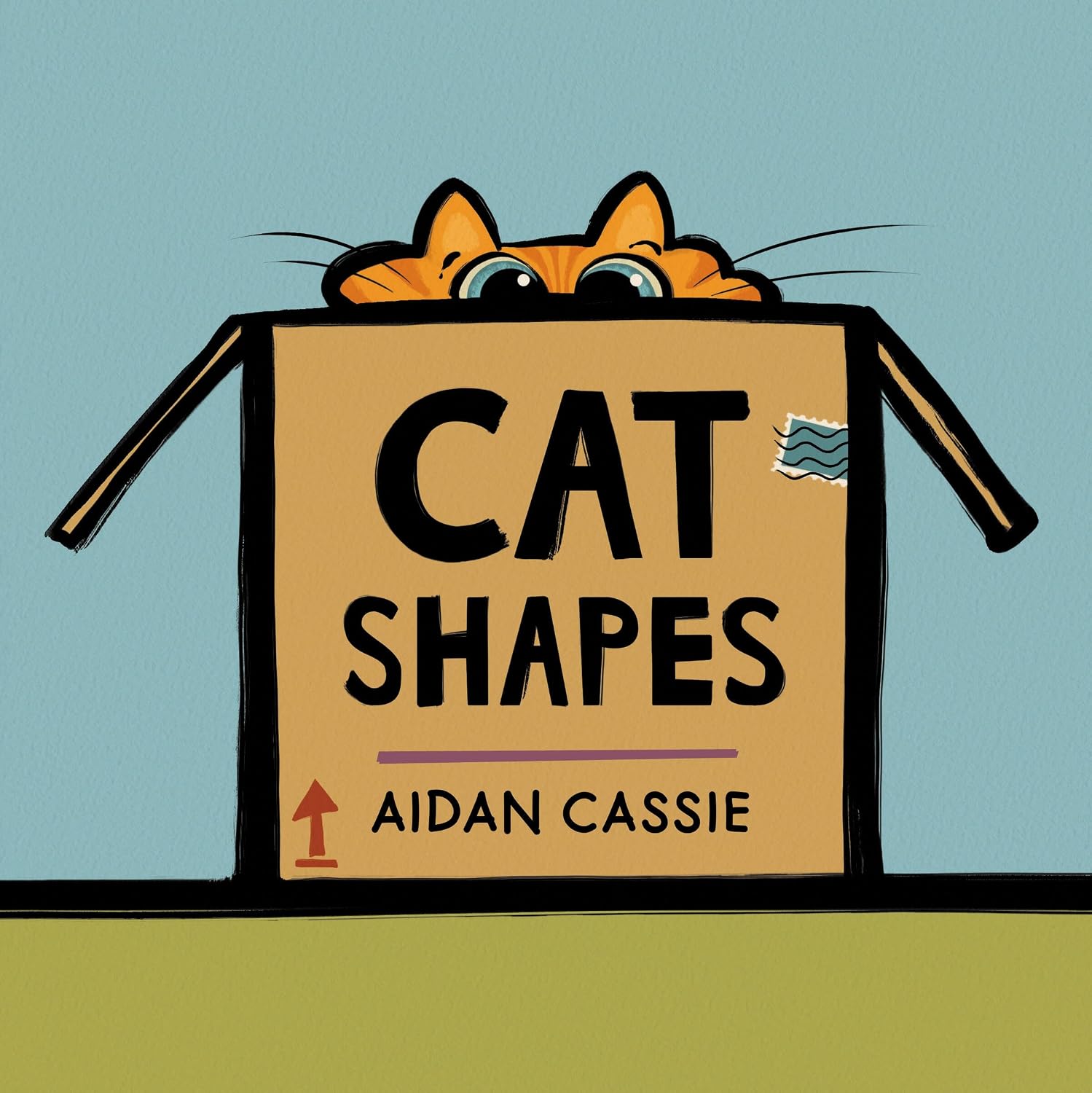
Cat Shapes by Aidan Cassie is a fun romp through a day of a cat and all the shapes it can take on: from a square in a cardboard box to an oval in the sink. There is a sneaky cat, a sunning cat, and a curious cat. But the best shape of all comes on the last page of this board book for the youngest readers. A cat fits perfectly into your heart…

After reading this with Your preschool or kindergarten students, see how many shapes the children can take on! ISBN 978-1-5253-1327-1, Kids Can Press

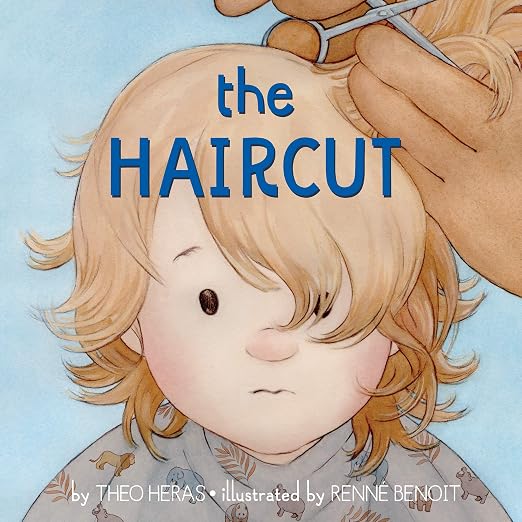
The Haircut, written by Theo Heras and illustrated by Renné Benoit, is a board book story of a first haircut for very young readers. The lovely drawings show a barber shop, a chair that can go up and down and a child whose’s curls are snip-snipped until there’s no more hair in the eyes. A nice story to prepare little ones for a real haircut. ISBN 978-1-77278-356-8, Pajama Press

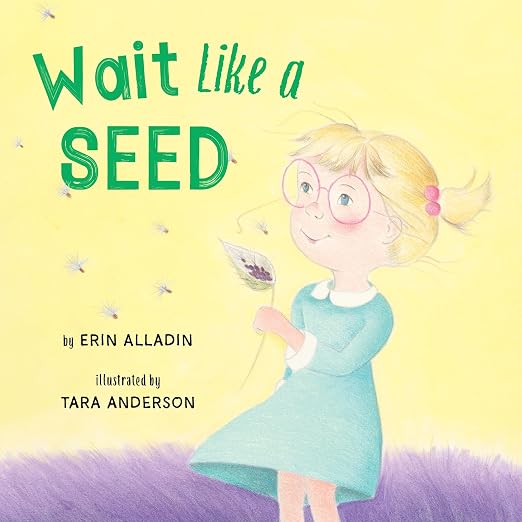
Wait Like a Seed, written by Erin Alladin, illustrated by Tara Anderson, is a perfect picturebook to use with Kindergarten and early elementary students. Written in a simple rhyme, the story shows the life cycle of milkweed and its relationship with monarch butterflies. Waiting like a seed, reaching like a sprout – the words can be accompanied by movement games in the classroom. If your students hatch butterfly chrysalis in the classroom, this story will be a great text to use. ISBN 978-1-77278-359-9, Pajama Press

Love, Panda by Elaine Su, illustrated by Charlene Chua, is a wonderful picturebook for little ones, especially those who are a big brother or sister to a new baby. Panda used to be owned by Benny but he’s been left in the baby’s room! In a panic, Panda writes Benny a note asking him to come and rescue Panda. Each page is a new note written by Panda. At first he complains bitterly about this new baby who drools and burps. But gradually the notes get less urgent. Panda’s facial expressions change until he’s a happy, smiling Panda again who actually chooses to keep the baby company. ISBN 978-1-5461-7958-0, Orchard Books

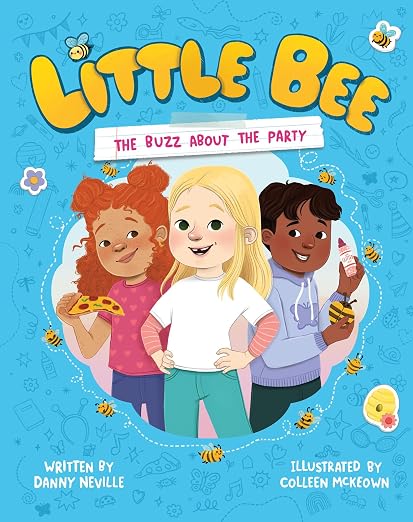
Little Bee: The Buzz about the Party, by Danny Neville (who was a teacher at International Schools), with illustrations by Colleen McKeown.

This beginner’s novel is a fun, upbeat story about Bee and her best friends. When their teacher announces a special contest for the best plan to celebrate Mother’s Day, the students get busy making plans and crafts. But the idea also causes concerns for students who don’t have a standard family of a mom, dad and kids. Bee has two dads. Her friend Santiago lives with his grandparents. Another one has only a mom. How can all the children celebrate this special day without causing anyone hurt feelings? Bee and her friends come up with an all-inclusive plan that allows all the students to participate. Working together, even the most difficult child in class is happy to be part of the plan and the party.

A great read in which children of many diverse cultures and families can recognize themselves. This first book in a series will soon be followed by more titles! ISBN 978-1-83402-047-1, Annick Press

Margriet Ruurs is the author of many books for children. She is available for author presentations at International Schools.

www.margrietruurs.com

Pulling, not pushing

Suggested tasks to pull into the second week of IMPACT learning time at Eastwood Montreux, Switzerland.

The opportunity to start an alternative program for high school students, with a steady green light from the top administration, doesn’t present itself all that often. In my own education career, about thirty-five years worth, I can think of one summer camp, one public parks program, and one school that gave the space and time to go out on a limb with truly cutting edge programming. And now again, Fall 2026, another school is providing that opportunity.

We’ve set the curriculum up as a pull system, something I learned about over the last ten years and have written about a few times. Pull systems encourage taking on the next task when you have space and time for it. When that new task is most needed and helpful. When it fits with what you already know and what you need to know. 

Maybe thinking about the opposite of pull makes a pull system clearer. The opposite is of course a push system. I would classify our traditional approach to schooling as a push system. The curriculum is usually prepared before the teacher meets any students, instruction is sometimes planned and scheduled with limited ability to react to what students actually demonstrate in knowledge and ability, and the students themselves are grouped by age level, making the teacher’s job with both curriculum and instruction difficult. Tests are pushed out at certain times, standards are pre-set, Push, push, push.

So we opted for a pull system. We have lots of resources and activities that are ready to be pulled into class, week by week or even day by day. Students pull specific work into the class period according to what they believe will be most helpful for them. We’ll coach along the way, of course, but our default position is learning from observing the choices students make. Do they see what can be helpful, what they need to learn next? And do they learn from the process of having to make decisions about what to learn? We believe they will.

Here are two examples from our first week of the IMPACT program that give me a whole lot of confidence. They both happened on the first Friday of the program. (Names are pseudonyms.)

Brad and I have ten minutes for some informal coaching. The point is simply for me to hear from him what personal passion project he is thinking about. I know he has several projects in mind, so I go into our short meeting thinking I’ll help him narrow his focus. But Brad opens his computer and begins with a professional-looking pitch for the creation of a Learning Management System (LMS) for our program. He isn’t trying to sell me on Moodle, Canvas, or Powerschool. He wants to build an LMS himself. He starts with the Why (the students discussed good pitching the day before) and gives examples of how the LMS would help students and coaches focus more on their projects and less on the administration of the program.

Brad and I talk about possible next steps. I ask who he might collaborate with. There isn’t any reason not to see what Brad, and hopefully a few of peers, could put together for us. He has clearly shown me that the work could have a positive impact on the program. After we consider possible next steps for a bit, Brad sits back and wonders aloud whether or not the school’s administration is already working on an LMS. He decides he had better talk to the administration. My role is mostly to nod and agree. He’s pulled a meaningful project into the curriculum, he is personally motivated, he knows what to do next. I couldn’t be more satisfied.

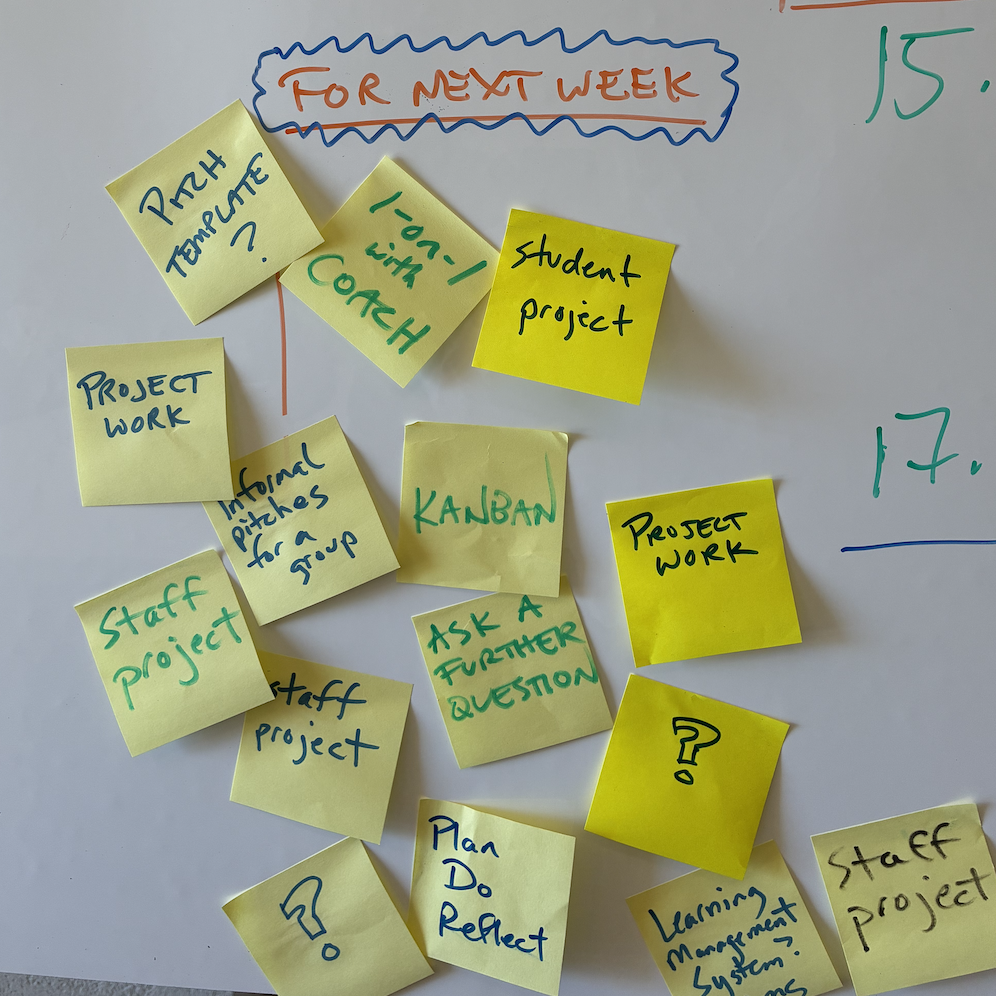
Nancy has asked for some time to speak with the cohort of students and coaches. There is a sticky note on the board, reserving her place in the afternoon’s agenda. “Student Projects – Nancy.” So we turn our attention to her. Nancy would like to make a movie. She describes to us all, as we sit in a circle around pushed-together tables, what she has in mind. And then she  summarizes with a polite shrug, “So yeah, that’s it.” 

Students immediately begin asking questions and offering suggestions. That’s a great idea! What genre do you think? How long do you think it will be? You should be the producer, but yes, you can be an actor, too. Who is going to write the script? Where will you show it, how about YouTube. You’ll need to get permission from anyone in the movie. Can I have a role? 

I’m guessing these are the type of students who would jump in and ask questions like this simply because of who they are. I also think it doesn’t hurt that we’ve been specifically practicing a Harkness-type round table approach where we look out for each other, try to be inclusive, and avoid dominating the conversation. In fact, after class I have a chance to quietly compliment Lance on how politely he took the floor and how politely he passed control back to others. “Oh, I had more to say,” he told me. “But I didn’t want to dominate.” Right, excellent. There’s a skill that goes far beyond any specific content area! Another student, Ethan, asks me during the break if he can have time on Monday to talk about his project. Sure, I tell him, we’ll make a sticky note, you can propose it when we build the schedule for the week. I’m guessing he’s pulling a personal project topic into the curriculum, just as Nancy modeled for us earlier. We’ll hear more on Monday. 

Pulling, not pushing. It isn’t exactly turning curriculum and instruction on their head. I wouldn’t say it is radical. But it is fairly far from the norm. We are collaboratively building a curriculum in real time through the perceived needs of students and their own motivation. We’ve given them a goal (a passion project that has personal and external impact, with deliverables in six weeks time) and they are working toward the solution. Brad wants to manage the oncoming flurry of work by building an LMS for everyone. Nancy wants to make a movie, and Ethan is going to share his proposal with us on Monday. I’d say everyone has caught on to the pull system very quickly. Maybe, just maybe, this is a repositioning for curriculum and instruction that gracefully aligns with how we think and act. 

And maybe there’s a pedagogical nugget here for all of us, a piece of learning that is applicable in most any teaching context. Entrust your students with responsibility. They will most likely amaze you, not fail you.

More Looking Up in a Digital World

Ten days in Patagonia.

No scroll. Pure joy.

This summer I led a student trip to the furthest southern point of the Americas and students did not have their phones. This meant no notifications. None of the thoughtless, default checks when there was a pause. And no endless tech dips into the little dopamine wells that have become so easy to access. 

Purely Patagonia and we all were all in. 

What captured our attention was the very “why” we were there. Ice fields, mountain passes, the cold wind and snow in our faces. We traversed in crampons across glaciers and on other days, our skis cut across and down the slopes. 

When the Phones Went Away

The ten days our screens went away, the group bonded. Clearly, at first there was a little push back and noticeably, it felt like something was missing. That’s because it was!  So accustomed to filling the  spaces of the day with technology, any empty space (a bus ride or moment alone at the breakfast table) could feel almost uncomfortable. Yet, adapting was as seamless as it was quick. Like a vacuum, other things filled those cell phone free spaces. What became immediately clear was how when we removed the phones, we didn’t remove the need to fill the space. We simply discovered what else could fill it!

Something Else Always Fills the Space

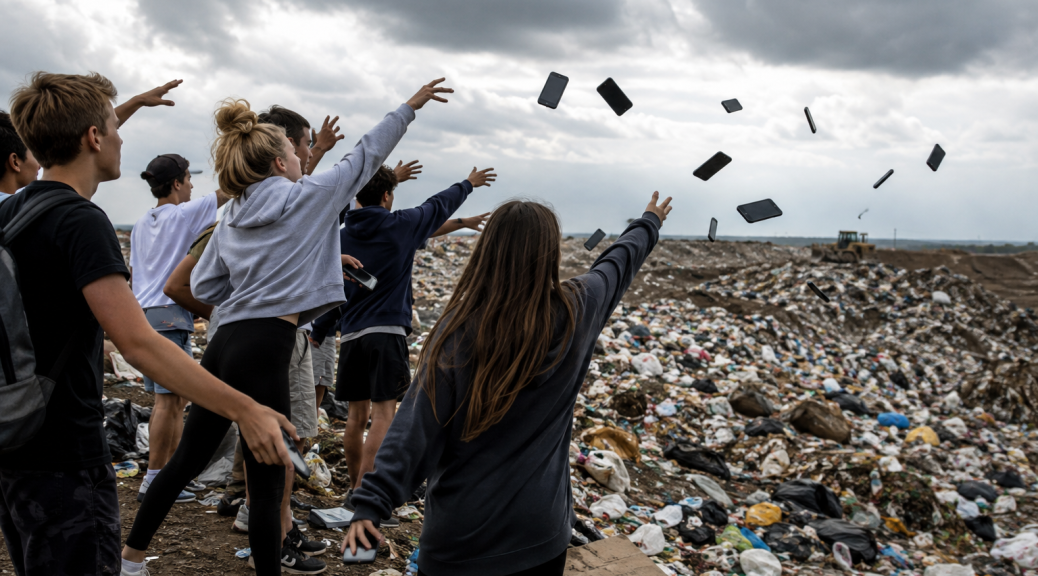
Conversations, innumerable ping pong matches, card games, shared meals, and one of my favorites to watch…a puzzle that was on the table at one of the hostels. Over a couple days, nearly ten students rallied around the puzzle and before we left, the scene was complete. Wish it were a smiling teen burying their phone in the landfill. Instead it was an idyllic scene from the region.

Besides robust laughter throughout the days (and late nights!), we all rediscovered the surprisingly rich experience of just being around other people without needing anything from a screen.

Returning home, school began a few days thereafter. Stepping out on a bold new branch, this year students and teachers were being asked to put the phones away. After the first day of classes, an administrator shared a gracious e-mail to the entire community. The subject line, *Mahalo (thank you) for showing up with such positive energy.” Her intent was to follow up with a few observations regarding the first day with no phones and highlighted most was how everyone seemed to be looking up a whole lot more. 

For all of us, the absence of cell phones made a noticeable, even palpable difference. Instead of screens, everyone was seeing each other. 

This all matters because changing our relationship with technology isn’t accomplished by simply declaring a new rule. It happens through thousands of small choices, repeated until they become habits. And we are all building those habits together. Not proud to admit it, I can honestly say that I too feel addicted to my phone. Is it my phone or the dopamine? The reward of an answered e-mail?  The pleasure or satisfaction that I seemingly find when I crook my neck and squint at my phone? 

Most mornings I reach first thing  for my phone, which is excused for being at my bedside because the clock and alarm are there.  Furthermore, I usually make one last check at emails before going to sleep. This too “excused” because our timezone is so different and maybe someone needs to get a hold of me. 

Enter Nope-amine

So, this brings me to how I am choosing to begin my days. Conscious, after doing my best to recollect any dreams I may have, I think of the word  *nope-amine”. We spend so much of our lives chasing tiny, immediate rewards through technology: check, scroll, refresh, respond, repeat.

Nope-amine is the opposite.

It is the small pleasure of saying no. No, I don’t need to check. And I definitely don’t need to check first thing in the morning. The “nos” can roll on.

No, I don’t need to capture this moment. No, I don’t need to fill the silence.

Similar to the experience with teens in Patagonia, I am discovering what becomes possible when I say “nope.”

Seemingly, Patagonia made this a bit easier. It was difficult to be distracted by my phone when we  were climbing across Perito Moreno. It seemed unnecessary to check my email when we were backcountry skiing (Not so tough on the long chairlift the mountain on the resort however!) 

Guess it’s about being in the moment and choosing to be. It is just that…a choice. An adventure really. One that is not only okay with, but may relish, in quiet and uncertain moments. Owning our attention is considered by many to be of greatest value. Money is infinite in a sort of way. Able to be  earned again or even printed anew. Time however is finite. But attention moreover  is even more interesting: you can have time available and still lose its value if your attention is fragmented. 

This need not be a proxy war. Nor any war at all! The goal is not to declare technology the enemy. Technology is extraordinary. It connects us, helps us learn, allows us to create, and gives us access to an almost unimaginable amount of information.  Yet, we might be wise to distinguish between a difference in using technology and technology using us! 

The Patagonia experience offered a reset. Similarly, the first day of school and our new policy. 

More Looking Up

In Patagonia we traded notifications for mountains. Scrolling for skiing.

In school we are trading algorithms for conversations. Streaks for in-person friendships.

Lest we remember something that is easy to forget, a life worth paying attention to is happening right in front of us.

For a few years now, in my entrepreneurship courses, I have dissuaded students from the knee jerk default to want to create an app. This being because sometimes the best technology intervention is not a better app, a new setting, or another productivity hack.

Sometimes it is simply putting the phone away.

In Patagonia, we looked up because there were mountains.At school, students are looking up because their phones aren’t in the way.

And perhaps that’s what we’re really trying to recover. Not less technology, but more looking up.

Ferris Bueller’s Day Off was my favorite movie when I was the age of the students I now teach. I think Ferris said it best, “Life moves pretty fast. If you don’t stop and look around once in a while, you could miss it.”

#####################

When worlds collide

From https://themindreels.com/2012/09/05/when-worlds-collide-1951/

Sometimes the juxtaposition of two ways of thinking makes you sit up really straight or feel that you’ve skipped a heartbeat or two. The feeling of worlds colliding, and in my case this past week, bouncing off each other. Some of the LinkedIn posts I’m seeing are messing with me. Really!

We’ve been working hard at Eastwood Montreux to prepare for the start of the academic year, the inaugural academic year at this unique school. Together, my colleagues and I are building a process in which teachers and students co-create curriculum. It’s our attempt to make as much space for authentic student agency as possible. Not just a choice between A or B and not merely tinkering at the edges of traditional curricula, and certainly not student-input-for-show on decisions that have already been made by the adults. We are trying to go all in on co-creation. Processes, materials, timing, projects, groups, feedback, demonstrations, all to be co-determined with students. If you are going to teach agency, after all, you gotta make space for students (and teachers) to practice agency. 

Daring. Scary. Visionary? Maybe. Decidedly out of the box, that’s for sure.

So we’ve been talking about our values for the program and modeling for each other processes and sample content. It hasn‘t been easy for us adults. We have to constantly remind ourselves not to over-structure the curriculum, determining when, by whom, and in what way. We’re having to ask questions, not provide answers. And we are unlearning very ingrained habits of teaching. We’ll be asking the students to unlearn equally ingrained habits of schooling, too. I don’t anticipate this will be easy. In fact, from previous alternative programs I’ve been involved with, I know it won’t be easy. Unlearning many of the central assumptions of school, assumptions that individuals have rehearsed for years and generations have grown comfortable with, is heaving lifting. 

I’m happy to say we’re making progress in our initial iterations and that we’ll continue to make progress after the students arrive, iteration by iteration. All year long and beyond.

But those LinkedIn posts. Lots of them now, at the beginning of the school year. Some of the posts inspire me and many give me that jolt when worlds collide. It’s their schoolishness I’m reacting to, I realize. Grading policies, assuming a single teacher at the head of the room, the emphasis on rewards (and punishments), the predictability of curriculum, putting students in classes by age instead of readiness. It’s so schooly, which yes, has sometimes served well. But it’s so not the mindset we’re working on, it’s not our vision for the future of education.

Sharing stories, expertise, and experiences from international educators around the world. In the spirit of amplifying diverse voices. TIE's blog space is not subject to editorial oversight. TIE bloggers have a long history in various aspects of international education and share their thoughts and insights based on personal experiences.