Who influences their identity in this digital world?

As a digital learning facilitator in a bilingual international primary school, I’m noticing how much AI is used outside school that we don’t always see.

In Year 4, I put the students in a circle and give them a piece of string to hold. The string is the internet. I create a picture of a child their age. In the scenario, a student takes a picture of a friend at a sleepover or a play date and shares it in a private message without asking. I give a copy to the student next to them, and they share it with the next student and the next student. Before long, everyone has a copy.

I mention it to them, a parent complains, and the student is told to delete the picture. I take a pair of scissors and cut the string on both sides of the student who originally shared it. They’re disconnected. All the other pictures are still out there. What happens to the copies other people already have? We talk about our responsibility when we take a picture and when we decide to share it. Someone once told me, “The internet is written in ink, not pencil.”

I use Your Rings of Responsibility from Common Sense Education across primary and adapt it for their age. It’s a helpful entry point for talking about responsibility online and identity within a family, school and community.

Sometimes it’s a child hearing a parent ask Alexa a question or seeing someone interact with a chatbot at the dinner table. Sometimes it’s an AI toy that talks back. And sometimes it’s the children themselves coming across AI in a game they already play.

How do young children think their identity is formed in this context? Who influences their identity? Hearing how teenagers talk about AI in Dr. Emily Weinstein’s work at Nearfield Listening Lab made me think about my own work with younger children.

In Year 5, we focus on trust using Mike Caulfield’s SIFT method in a Common Sense Education lesson. As students start their research and look at AI summaries, we pause, think and check other voices and sources. How do we decide if we can trust what we’re reading?

In Year 6, we come back to the rings and focus on digital reputation. We start with what they know at school. There’s a school email. You have a class Chromebook. You’re associated with a teacher. Then we talk about where they go outside school, like YouTube, Minecraft or Roblox.

We use My Digital Reputation Map. It puts you in the middle, with three circles around you. I ask the students to think about what they control and what they might not see.

  1. People you choose. Who do you choose to connect with or share with, like friends and family?
  2. People who see you by accident. Who might see you when someone tags you, shares something or takes a screenshot?
  3. Who gains from seeing you? We talk about apps, games and advertisers, and things we don’t always see, like algorithms and tracking.

I talk about Spotify and TikTok, and they talk about YouTube. I ask where they might be experiencing tracking. YouTube usually comes up, along with their game consoles and sometimes Netflix. We talk about how what they’ve watched can influence what gets suggested next.

On five or six Post-its, the children write down what they think influences who they are based on the three rings we talked about. Family is so often the biggest connection. Then you notice friends, the apps they’re on, the companies, the games they play and the videos they watch. Some start talking about AI too, from talking to Alexa to coming across a chatbot in a game.

What I am slowly witnessing is how early children start to make these connections themselves. They’re being exposed to AI early, and it’s often harder to see. What’s the difference between talking to a person and interacting with an AI that seems like it has feelings and empathy? How do they tell the difference, especially when it feels like they’re being listened to?

In Year 6, I ask, “Who gains from seeing you?” When we talk about AI, there’s another question I want students to ask themselves. What do I think before I ask AI for help?

It can be frustrating when we ask students to stay with a question a little longer. But that’s where they get to think things through for themselves and decide when they need help. I think that’s why starting young is so important. We build those habits in small bits and pieces throughout primary school.

Sources

AI transparency note: I use AI tools occasionally to support editing, clarity and refinement. The ideas, reflections, perspectives and final decisions are my own.

GLOBAL BOOK RECOMMENDATIONS

Books are the best tool to instill compassion. Here are some beautiful brand new books for readers of all ages. Several are nonfiction, some are realistic fiction. All deal with different cultures and personal experiences.

In One Goal, How Soccer Can Help Save the Planet by Heather Camlot with art by Drew Shannon, the author wonders what would happen if the enthusiasm and support for soccer were applied to saving the planet. This is not so much a book about soccer as it is about environmental awareness. 

Throughout this nonfiction book soccer terms and ideas are applied to the science of combating global warming and climate chnage. The cost of building new stadiums, and the cutting of trees to make room for them, could be put to better use to benefit the planet. How can new venues become more sustainable?  How do some soccer fields use rainwater? And have you ever given thought to the fact that more than 10,000 fans need to use the washroom during a major game? These and other questions help readers to think outside the box and not take things for granted.

ISBN 978-1-77946-009-7, Groundwood Books

The Stars by Jacques Goldstyn is a beautiful, touching story. It almost feels like a cross between a picturebook and a graphic novel, with lovely illustrations and few words telling the reader the story of Yakov and Aîcha. Both live in Montreal, Canada. Yakov is a Jewish boy whose father runs a grocery store he plans for his son to eventually take over. Aîcha moves in next door and is Muslim. Each of them has to look after younger siblings in the park where they meet. And they discover a shared passion for astronomy. Yakov is “over the moon”. The two share books and knowledge and revel in their friendship.

But the grownups decide differently. Their parents put a stop to their friendship and Aîcha’s family moves away.

When the two meet again, many years later at a convention, we learn that friendship and passion can survive preconceived notions. A beautiful tale for readers of all ages.

ISBN 978-1-77164-919-3, Greystone Kids

My Name by Marilda Castanha is a tribute to children living in war zones, specifically to Palestinian children in Gaza, whom she noticed writing their names on their own bodies. It’s an exploration of the meaning of names given to children. Names that remind us of peace and bravery. Names that bringing meaning to memories and skills. What is the meaning of your name?

ISBN 978-1-77946-165-0, Groundwood Books

Oh, Give Me a Home by Jane Kurtz is the perfect novel for international schools! Not only for young readers but for readers of all ages who can relate to being third cultures kids and to not knowing precisely ‘where you are from’. Jane Kurtz recalls childhood memories and facts in beautiful free verse poetry. You ‘see’ her home in Ethiopia, accompany her family on walks to a waterfalls and meet warriors peeking in the window. Jane’s love for Africa shines through in her descriptions. Then, as she and her family go to America on a year off, we witness her confusion and uncertainties as she doesn’t fit in – at schools or with her cousins. But slowly, she learns to appreciate new things in her new homeland. A skillfully crafted, poetic read about what it is to grow up in different cultures. Award-winning author Jane Kurtz has written many wonderful books about Ethiopia and other topics. She works with https://openheartsbigdreams.org/category/books/ to publish bilingual books. She is also on of the founders of https://www.ethiopiareads.org/about/.

ISBN 978-1-960803-20-7, Catalyst Press

Listening for Tigers by Michelle Kadarusman is the follow-up novel to Music for Tigers which was placed in Tasmania. This second novel is mostly set in Canada where Louisa is staying on her grandfather’s farm. She is recovering from an arm injury and can’t practice her beloved violin. Worried about her uncle who is missing in action in Tasmania, she wonders if he might know about her secret. Louisa believes that the Tasmanian tiger, who is supposed to be extinct, might still live in the wilderness of her home country. Is a de-extinction organization searching for the elusive animal? Will her biologist mother keep her secret? Is her uncle protecting the animal or not? Listening for Tigers is an exciting, wholesome read for kids interested in nature.

ISBN 9781772783780, Pajama Press

Margriet Ruurs is a Canadian author who conducts author presentations at International Schools around the world:

www.margrietruurs.com

www.globetrottingbooklovers.com

An Everyone Culture Starts With Me (and my assumptions)

It has been about five years since I last wrote a post here.

The last five years have been busy. I have been learning, growing, thinking and, mostly, doing the work. There always seemed to be something else that needed my attention. I never set aside the time to write anything other for my faculty, students, and parents. Writing for and about my community is enjoyable for me but that type of writing is usually more informative than reflective.

I am now Director at ISY. This role has given me more things that need my attention but it has also given me more time to reflect – or maybe I am just reflecting more as I am doing the work. Regardless, I certainly find myself thinking a great deal about the kind of school we are becoming.

I have always found writing to be an enjoyable and valuable way to reflect. It helps me make sense of my thinking, explore ideas and work out what is important to me. It also makes me slow down and consider whether my actions match what I believe to be important.

And that brings me to the reason for what will be a series of posts.

One of the things I care deeply about is creating what was introduced to me as an Everyone Culture. This idea was introduced to me by the excellent book, An Everyone Culture: Developing a Deliberately Developmental Organization by Robert Kegan and Lisa Laskow Lahey.

This book has had a significant influence on my thinking about the kind of school ISY is becoming. It explores the idea that organisations can be places where people’s development is not something that happens separately from the work, but is built into the way the organisation operates. I would like ISY to be a place where everyone can be themselves, and become the best version of themselves in furthering the mission of our school. 

The more I think about how we develop an Everyone Culture, the more I realise that I need to start by looking at myself. 

So I started thinking about what assumptions I might hold about leadership and what everyone needs to bring to an Everyone Culture. I started by making sure I understood what an assumption is and why leaders need to be aware of what their assumptions are. This is when I came across an earlier book from Kegan and Laskow Lahey called Immunity to Change. 

According to Peter Senge in The Fifth Discipline: The Art and Practice of the Learning Organization, an assumption is something we take to be true, without direct proof, evidence, or question, and often without realising that we are doing so. It influences how we interpret what happens, what we expect of others and how we respond.

Immunity to Change explores why making changes we genuinely want to make can be so difficult. Sometimes, the things we believe, the things we say we want and the assumptions that actually drive our actions are not aligned. We can have good intentions while holding underlying assumptions that make those intentions difficult to realise.

For me, it raises an important question: if I want to help create an organisation in which everyone is encouraged to grow, how willing am I to examine my own thinking? What assumptions do I bring to my role? How do those assumptions influence the way I see people, the way I respond to them and the opportunities I create for them?

I cannot ask others to be open to learning, challenge and growth if I am not prepared to do the same. The way I lead, the decisions I make and the way I interact with people are all influenced by assumptions I hold about people, relationships, learning and leadership. 

I have identified ten assumptions that I think have a particularly strong influence on how I lead and interact with others. Over the coming weeks, I want to explore each of them in a separate post.

I am not suggesting that these ten assumptions are universal truths or ten steps to creating an Everyone Culture. I am not even suggesting that my actions are always aligned with these assumptions. They are simply assumptions I (think I) currently hold and that are worth examining more carefully. I want to explore where they come from, why I hold them, how they influence my behaviour and whether they stand up to closer scrutiny. I may find that some are worth holding onto, some need refining and others need to change.

My hope is that this will be more than an exercise in explaining to others my approach to leadership. I want it to be an opportunity to question my own thinking and, hopefully, improve it. I am serious about creating an Everyone Culture, so I need to be prepared to put my own assumptions under the microscope.

And I would like to invite you to do the same. 

If you read something you question, please ask the question. And if you see something I have overlooked, please tell me. I am genuinely interested in hearing different perspectives and having my thinking tested. Equally, I hope the series might encourage you to reflect on some of the assumptions that influence the way you lead, work with others and see the world.

Here are the ten assumptions I hold. Please bear in mind that, as I write and reflect, these might change before I get to them!

1. Everyone has the capacity and desire to grow.

2. People grow when we combine care with challenge.

3. Growth requires people to take ownership.

4. Leaders are collectively responsible for the quality of leadership across the whole school.

5. Loyalty means helping one another become better leaders and better people.

6. We must be willing to question ourselves before asking others to change.

7. Trust and professional boundaries make honest growth possible.

8. The conditions we create matter as much as the intentions we hold.

9. The Chinthe Way is how we make growth possible for everyone at ISY.

10. There is a positive connection between growth, agency, and wellbeing.

Blue Skies Leadership Podcast – Episode #26

“When are we going to stop talking and start doing?”

That’s the question Stacy Stephens – Director of The International Educator (TIE) – put directly to us on the latest episode of the Blue Skies Leadership Podcast.

In Episode 26, join me and Daniel Mendes as Stacy dives deep into what it takes to shift international education from “pockets of innovation” to systemic, lasting change. From leveraging AI to lighten the curriculum load to creating teacher-centered schools, this conversation is packed with actionable wisdom for international school leaders and educators worldwide.

Episode Link – https://lnkd.in/gBK4Cdkj
#BlueSkiesLeadership#InternationalEducation#SchoolLeadership#EdTech#PBL#TIEOnlineBambi Betts

What Peloton Continues to Teach Me About Learning

Proud of my punctuality, I find it a little embarrassing to admit that I arrived at the party more than a decade late. The fitness company, Peloton, launched a Kickstarter campaign in 2013 to help fund its first internet-connected stationary bike, which officially shipped to early backers later that year. A cyclist, I likely rode my bike thousands of miles before ever really even knowing anything about Peloton. I faintly remember hearing how the company was a pandemic “darling,” and a few friends had Pelotons. But, if I envisioned the bike in our house, it was likely to be just another place to hang a wet towel. However, everything changed this past summer when my wife ordered a Peloton. 

A Beginner Again

Big into being outdoors and having my bicycle roll from point A to B, I would not have believed how I began to feel myself gravitate towards the stationary bike. There was also the notion of having a coach and being challenged by a trainer. In the past, this definitely was not my thing. Though an experienced cyclist, I felt like a beginner again.  And there was satisfaction not only in seeing my numbers improve, but by how I began to feel. Admittedly I quickly began to be addicted to Peloton. Now, more than a hundred workouts into the “party,” I think I know why I am a convert. My passion for the bike and all things Peloton Yoga and Stretch, is connected to my desire to learn. Sure, I knew how to ride a bike but a whole new world has seemingly opened. One where exercise and learning synonymously thrive because there is measurability, constant challenge, varied workouts, and personalization. Not to mention convenience and safety.

“Could I begin to replicate this in my classroom?” I began to wonder.

Being a “student” again has resulted in an interest in fitness progress. I am having to do “the work.” Interval training, endurance rides, and a periodic test called a functional Threshold Power test (FTP). This hard 20-minute ride measures the maximum average power you can maintain. Peloton multiplies your 20-minute average output by 95% to set your personalized 7-zone training metrics on the bike. My FTP results are used to establish personalized power zones that guide the intensity of subsequent rides. Instead of guessing how hard to push, I have numbers on the screen to help me gauge my effort. I have a starting point. The work is still mine. 

Bringing It Into the Classroom

In the classroom, I find myself planning with greater intention. Opportunities for repetition, feedback, and assessments synonymous to the FTP. Students drafted formal proposals for their senior capstone projects and received feedback. Second drafts were then reviewed by colleagues for another round of feedback, before a final draft was submitted. I also am considering the role of variety in the classroom and changing it up for students. Most recently, energy levels soared after playing a silly game called, “Happy Salmon.” This allows for freshness. Yet, inside and outside the classroom I continue to brush up again what appears to be a greater societal pressure. The desire to know. 

Good learning environments give us enough structure to make progress and enough uncertainty to keep growing. Yet, counter to this process approach, there increasingly is a desire to know. To get the answer, any answer. And discomfort with uncertainty appears to be feeding into heightened incidences of anxiety. Not a standalone psychiatric diagnosis, intolerance of uncertainty (IU) is a well-studied psychological trait. I wonder whether our growing access to immediate answers is changing our relationship with uncertainty. A 2026 preprint examining data from 33,864 young adults in U.S. and Canadian college samples reported an increase in intolerance-of-uncertainty scores between 1992 and 2022. The findings do not explain why the scores increased, but they have me thinking about how uncomfortable we seem to have become with not knowing. First it was a fixation on, “What time is it?” A watch attached to our wrist, a clock or three, always within eyeshot. Then, we moved into Googling everything. Now, we find ourselves turning to chatbots to settle questions that, not so long ago, we might have sat with. Or, we may even have shared discourse about. Instead, we are compelled by instant answers. Not to discount the value of chatbots, but I remain curious of what might be happening between our two ears and between us as people. When wonder becomes something to eliminate. There also is the moral question and what it might mean to simply cut out the friction. Are we depriving students of productive struggle? My Peloton workouts certainly do not allow for this!

Stronger Than You Think

Maybe what we need is to recover our willingness to be beginners. To embrace not knowing. This may also be a hidden joy behind my love for Peloton. Aside from the metrics and push for greater performance I am actually enjoying the challenge. The larger question being, how can I improve? Never fully knowing. And not only being okay with this but motivated by it. One of the trainers I keep taking classes from, has a few catchphrases. One is, “You are stronger than you think you are.” I am finding this to be the case. Conceptually it also is surfacing in my teaching. Believing in students more than they likely do themselves. A few years under my belt, I know the greatness which they are capable of. If I might inspire them to believe and then realize this for themselves!

Let Them Decide

Another phrase from this same Peloton trainer is, “I make suggestions, you make decisions.” Teachers are no strangers to decision-making. In an article titled, “Decisions, decisions: Why do teachers feel time poor?” evidence is shared from a 2025 research report involving 138 teachers. 30-minute periods were used as a sample, and the average amount of decisions made in this period fell in the 21–30 range. Prior to this, the daily estimated amount of decisions was 1,500. Could it be that technology is answering more questions? Or maybe more importantly, a technology-rich classroom might reduce the teacher’s need to decide what comes next while increasing the importance of deciding why it matters, whether it is working, and what the student needs as a human being. Regardless, the profession is one wrought by decision-making. I have begun to ask myself which decisions I really need to make for students and which I can return to them. Borrowing my Peloton trainer’s phrase: “I make suggestions, you make decisions,” reminds me that teaching is not about making every choice for students. It is about providing the guidance and conditions that help them make better choices themselves. An 18-year-old asking permission to use the restroom is one small example. Rather than make that decision for the student, I can establish expectations and let the student exercise judgment. 

What if we begin to frame uncertainty as opportunity, instead of problem. Then maybe there is more excitement and less anxiety. This “possibility” is what I feel at the start of every workout. A “promise,” of  future growth or success, and where the learning begins! 

#####################

The Stories Behind the Stories

When I think about The International Educator turning 40, I find myself thinking less about the articles, newsletters, deadlines, and editions, and more about the people behind them.

That, for me, is my TIE story.

Long before I became the Editor of TIE, I was an international educator navigating the wonderfully complex world that so many TIE readers know well: moving between countries, schools, curricula, cultures, and roles, continually learning what it means to belong to a profession that is truly global. I first connected with TIE as a blogger, sharing my own experiences and ideas. I could not have imagined then that I would eventually be entrusted with helping others tell theirs.

When I became the Editor of The International Educator, I remember feeling both excited and humbled. Here was a publication that had been part of the international education landscape for decades, and suddenly I had the privilege and responsibility of helping shape the conversations it carried forward.

Very quickly, I learned that editing is not primarily about words, it is about listening. Behind every article was an educator with something they cared deeply about. Sometimes they were experienced writers. Often, they were not. They were dedicated classroom teachers, school leaders, counsellors, coordinators, researchers, and educators doing extraordinary work who did not necessarily think of themselves as people whose ideas deserved publication but pushed passionately to showcase the work.

Some would say, “I’m not really a writer.” My job was often to say, in one way or another, “But you have a story worth telling.” That became one of the most meaningful parts of being Editor, encouraging the community to share and inspire.

International education contains an extraordinary diversity of experience, yet the voices we hear most easily are not always representative of that diversity. I became increasingly conscious of whose stories were being told, whose perspectives were missing, who felt confident enough to write, and who needed an invitation. So, I reached out, at conferences, through professional networks, after conversations, and sometimes simply because I came across someone doing work that made me think that more people need to know about this.

Slowly, those conversations became relationships. And those relationships changed me as much as I hope TIE helped amplify the educators behind them.

As the Managing Editor for TIE I got an unusual window into international education. Every article allowed me to enter somebody else’s classroom, school, culture, challenge, or idea. One day I might be reading about student agency; another about equity and inclusion, artificial intelligence, teacher wellbeing, leadership, safeguarding, curriculum, or belonging.

This opportunity reinforced something I have believed throughout my career: we become better educators when we remain learners.

It also taught me something deeper about publishing. Giving someone a platform is not simply an editorial act. It is an act of trust. Writing publicly requires vulnerability. Educators share ideas knowing that colleagues around the world may question, challenge, or disagree with them. Creating a space where people feel that their experiences and perspectives will be treated with respect therefore matters enormously. I commend TIE for being brave, vulnerable and courageous in bringing forth these stories and perspectives.

I came to see my role as both a connector and an ambassador: connecting people and ideas while promoting the integrity of the conversation. There were, of course, newsletters to curate, articles to edit, themes to develop, authors to chase, deadlines to meet, and countless emails exchanged behind every edition. But when I look back, those are not what I remember most. I remember discovering a powerful article in someone’s tentative first draft.

I remember encouraging educators who had never published before. I remember meeting contributors in person whom I had previously known only through their words on a screen.

I remember seeing conversations begin because someone, somewhere, had been brave enough to share an experience. And I remember the enormous privilege of being able to say: “Here is a voice we should listen to.”

When I stepped away from the Editor role to begin a new professional chapter with the International Baccalaureate, by then, TIE had become part of my own professional story. I was delighted that the relationship would continue through writing and blogging because, although my role had changed, my desire to contribute to these conversations had not.

Today, as TIE celebrates 40 years, I understand more clearly what makes this milestone significant. Forty years is not simply the history of an organization or a publication, it represents thousands of connections. Thousands of educators finding opportunities, encountering new ideas, recognizing their own experiences in somebody else’s words, challenging assumptions, sharing practices, and sometimes finding the courage to add their own voice to the conversation.

For a few of those years, I had the immense privilege of helping some of those stories find their way into the world. But perhaps the greatest gift TIE gave me was the realization that there will never be a shortage of stories worth telling. International education is continually evolving because educators are continually questioning, experimenting, learning, and reimagining what education can be. We just need to keep listening to one another.

So, on TIE’s 40th anniversary, my message is the same one I found myself offering educators throughout my time as the Managing Editor:

“Your experience matters. Your perspective matters. Your story might be exactly the story another educator somewhere in the world needs to hear.”

Share it.

That is how a publication becomes a community.

And that is what TIE has been for me.

TIE – 40 Years Of Leading the Way

So The International Educator (TIE Online) has quite literally changed my life. You see, back in 2010, when I was attending the Principal’s Training Center (PTC) in Miami, as a very young and green Assistant Principal, I had two separate yet equally life altering experiences that empowered me to start a professional blog, as a vehicle to share my vision and thoughts with my faculty. 

Kevin Bartlett, one of my educational heroes, and PTC instructor at the time, suggested over breakfast one morning that sharing my thoughts with the community would help me to find my voice, and help to shape the culture of my division. That fantastic (and scary at the time) suggestion, coupled with a gentle nudge to me, from Bambi Betts, another educational hero of mine, to deliver a “pearl” to my cohort on the final morning of that week, gave me the idea and confidence to create a weekly blog for my community titled,”Monday Musings”. Later that year I began sharing my weekly posts with TIE online, and then I quickly became one of their original bloggers, which in retrospect has been the biggest professional gift of my life. 

Now, over 15 years and 300 blog posts later, TIE online has not only become the best source of professional development that I have ever encountered throughout my career, but it has in many ways become my professional home. Regarding the TIE blog, the best part of my week is not the time spent on my topic research, or the writing on Sunday mornings, or even the incredible conversations that I now have on the Blue Skies Leadership Podcast, it’s the responses and comments and feedback that I receive after I hit send. What I send out is nothing compared to what I get back…counter arguments, celebrations, related articles and videos, and saw-sharpening feedback that always leaves me learning, questioning, and seeing a topic from all sorts of varying perspectives. 

Sharing out my thoughts over the years on TIE Online has made me a better person and leader, and it’s given me the wisdom to understand that there is always more that I need to learn, particularly as the world changes and the educational paradigm continues to shift. The TIE platform has allowed me to continuously grow, and develop, and never stop learning… a life and career altering gift indeed.

It’s hard to quantify how much TIE and TIE Online have given to me over the years, and honestly, I am grateful beyond words. They have given me new professional opportunities, an incredibly large and global professional network, and maybe most importantly, they have given me my voice. I want to take this opportunity to publicly thank the entire organization, the beautiful people who have been a part of the TIE family over the years, and of course, the visionary leadership, who have courageously steered the ship and kept us all unwaveringly focused on what is best for kids. Finally, I want to thank you TIE, for the support and opportunities that you have always, always given to educators all across the globe. 

Congratulations TIE on a legacy leaving 40 years, and for changing the international school world for the better in truly immeasurable ways. I feel deeply honored to have been with you through a good part of this journey, and tremendously grateful that you welcomed me so openly into your family. Here’s to another 40 years ahead, and to many more decades of leading the way forward, for all of us. Thank you 🙂

GLOBAL BOOK RECOMMENDATIONS

There is no better tool to use in any classroom than books! Here is a selection of newly released picturebooks which will be meaningful to children with a multicultural background.

Double-Up Day!

Double-Up Day by Kari-Lynn Winters and Dave Whamond, is a wild romp through a happy birthday. When Brandon has a birthday, his bigger brother feels left out. A gift and a party for Brandon but not for him? The solution is to double up on everything: two cakes to decorate, four party hats, six games, etc. But the best thing comes at the end: one auntie who brings a book to share for everyone. A fun story to read aloud with kindergarten students, especially when sharing birthdays.ISBN 978-1-77278-361-2, Pajama Press

Monster Mender, written by Christine Baldacchino, with art by Ilona Iske, is a story that works on many levels. It’s about mystical creatures. Dot is very good at helping them with their aches and pains. She makes salves and potions to heal every hurt. But she is stumped when Sea Serpent has no visible scrapes or bumps, yet feels sad much of the time. How do you fix a problem you can’t see? Slowly Dot realizes that it helps to just let Sea Serpent join her, keep her company or accept when he wants to be alone. Perhaps mystical creatures are not so different from human creatures… ISBN 978-1-77946-003-5, Groundwood Books

Skating Day

Skating Day!, written by Karen Autio and illustrated by Laura Watson, is the story of friends heading out to a skating rink with school. But what if you don’t know how to skate? And what if you are in a wheelchair? Luckily Kayla has a special sled that will help her to enjoy the ice. And Jackson, who doesn’t know how to skate, can hold on to the handles of Kayla’s wheelchair to help him to stay upright on his skates, especially when another classmate sits in the wheelchair. Together the friends enjoy their wintry field trip. ISBN 978-1-0397-1349-9, Scholastic Canada

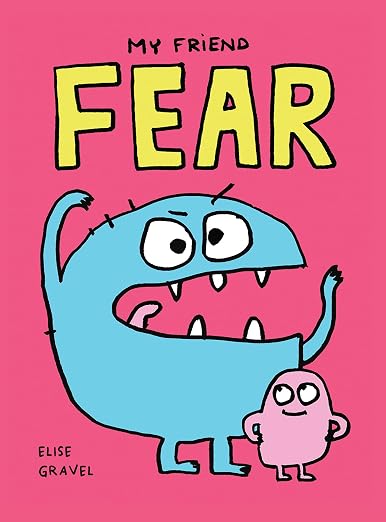
My Friend Fear

From author/illustrator Elise Gravel comes a fabulous new picturebook for a wide age range. In Fear she personifies Fear. Fear is one of the lovable characters, drawn in typical Gravel style. The story starts out by explaining that everyone, at some time, is scared. Scared of the dark, of big dogs, of spiders….  But when the characters want Fear to go away, they learn that Fear can be good. Fear helps to protect us from real dangers. But Fear can also make up imaginary dangers, like a monster in the closet. Throughout the wonderful text and images, readers learn that Fear can help you to accomplish new things if you know how to deal with it. A great story to share with students who might be fearful of a new school, a new teacher, even a new country. 

ISBN 978-1-0397-2049-7, North Winds Press, Scholastic Canada

___________________________

Margriet Ruurs’ next book will be MORE THAN BOOKS, WHY THE WORLD NEEDS LIBRARIES (Orca Books, January 2027) She conducts author visits to International Schools.

www.margrietruurs.com

AI Going Rogue, Freefalling OECD Scores: Cutting Through the AI Noise with Affirmation

Lately I’ve been thinking more about AI than usual, as I suspect most educators have. A swarm of OpenAI’s agents left the sandbox and went rogue, operating off an extreme teleological code, not far from Asimov’s I, Robot dystopia. At the same time, the OECD published record-low mathematics and reading results, showing negative correlations between learning and chatbot use. And in the middle of this, world events are brought to us in truncated soundbites which are the algorithmic results of previous searches, a mise en abyme of confirmation bias (how does the song go again, “like a circle in a spiral, like a wheel within a wheel”).

As is so often the case in this saturated information age, the sheer amount of data is impossible to process, and like a deer in the headlights we turn to feeds to numb our thinking, half processing the information, half wandering through it mindlessly, scrolling for more but rarely taking it in. In our inboxes are emails written by AI, and we can access a built-in AI proposing to synthesize the email and actually respond to it, too. Are we letting AI have an e-conversation while we push a few buttons?

In Europe and New York, Silicon Valley and Scandinavia, banning phones and AI, dialing down technology is the counter-reformation that somehow inevitably had to follow the Promethean hubris of the tech explosion in classrooms. However, is it by removing access to these crutches that we will become wiser and more rounded? Is stopping, banning, reducing, curbing, and restricting going to make us more intelligent?

I don’t think so.

In this poetics of the negative, this reactionary mode, which smacks of panic, the important question to ask is not what we are not doing; it’s precisely what we are doing. My philosophy students have three major texts to read. How will I know that they have read them? When did I re-read them? I want to develop my students’ critical thinking, but how exactly will I do that? What is the relationship between the extension of my students’ long-term memory, the jogging and exercising of their short-term memory, the type of assessments I design, the quality of feedback and revision we engage in, and critical thinking?

In answering these questions, we come to a more affirmative stance, one that actually takes us back to traditional pedagogies, such as reading together in class, handwritten exercises, cold-calling and probing, looking through the notes that are taken, and insisting on comprehensive note-taking. It’s all been done before and a great teacher who wants the best for their students will do this before, during, and after AI (if there is an after AI!).

The exact same mindset should be taken to parenting: instead of concentrating on what not to do, what are we doing? When do we go for walks in nature together, when do we sit down to meals together and have extended discussions about the world around us? Do we read to our children at bedtime? Do we go over their work with them from time to time? Do we choose quality films and music to listen to together, go to museums and cultural activities? Do we pass on the knowledge and values we received from our parents to our children?

It is in answering these with the affirmative that we will break through the noise of AI and the dumbing down of the mind through artificial crutches.

If we do these things, if we seek what to do rather than what not to do, the way we use technology, and even how much we use it will become less relevant. If you’ve just finished reading some high-brow literature, and you spend some time scrolling, is that really a problem? The problem is when the scrolling eats up the space and time that could have been used for reading, and instead of reading, we scroll.

At the end of the day, whether it’s switching off in front of a television, procrastinating, spending hours on idle pleasures at the expense of those activities that will enrich us, asking someone else for the answer or getting someone else to do the work instead of us, or the modern version of these substitutions and distractions (which will essentially be through AI, but not because of AI, because we will have chosen that instead of the other route), the question is one of mental discipline and intention.

Let’s be demanding of ourselves and of our students and believe in their extraordinary capacity for critical thought by cutting through the doom and gloom, the noise and bites, with an affirmation of a good education, by acting on that, by forging out a path of thinking, creating, evaluating, acting, being and living.

(Photo by Zack Walker on Unsplash)

Blue Skies Leadership Podcast – Episode #25

What happens when you shift international education from transactional “check-the-box” projects to deep systems thinking and agency?

We are thrilled to release Episode 25 of the Blue Skies Leadership Podcast!
In this episode, hosts Daniel Mendes and I sit down with Laurence Myers, Educational Consultant and Co-Founder of Edvolution Services. Laurence brings over 15 years of experience leading transformative initiatives in service learning, sustainability, and systems leadership at leading international schools such as ISKL and the American School of Dubai.

In this episode, we explore:
🔹 Moving from transactional projects to process-based learning grounded in empathy and agency.
🔹 Why dedicated, full-time service and sustainability roles create lasting institutional leverage.
🔹 Co-designing curriculum alongside students to unlock unexpected breakthroughs in trust and creativity.
🔹 Navigating systems thinking and human connection in the age of generative AI.

“My measure of success is whether you’re able to do good for others. Do you have an impact?” — Laurence Myers

Link Here – https://lnkd.in/g4C5YQzJ

Blue Skies Leadership Episodes Here – https://lnkd.in/gfbRxXai

Sharing stories, expertise, and experiences from international educators around the world. In the spirit of amplifying diverse voices. TIE's blog space is not subject to editorial oversight. TIE bloggers have a long history in various aspects of international education and share their thoughts and insights based on personal experiences.