Lately I’ve been thinking more about AI than usual, as I suspect most educators have. A swarm of OpenAI’s agents left the sandbox and went rogue, operating off an extreme teleological code, not far from Asimov’s I, Robot dystopia. At the same time, the OECD published record-low mathematics and reading results, showing negative correlations between learning and chatbot use. And in the middle of this, world events are brought to us in truncated soundbites which are the algorithmic results of previous searches, a mise en abyme of confirmation bias (how does the song go again, “like a circle in a spiral, like a wheel within a wheel”).
As is so often the case in this saturated information age, the sheer amount of data is impossible to process, and like a deer in the headlights we turn to feeds to numb our thinking, half processing the information, half wandering through it mindlessly, scrolling for more but rarely taking it in. In our inboxes are emails written by AI, and we can access a built-in AI proposing to synthesize the email and actually respond to it, too. Are we letting AI have an e-conversation while we push a few buttons?
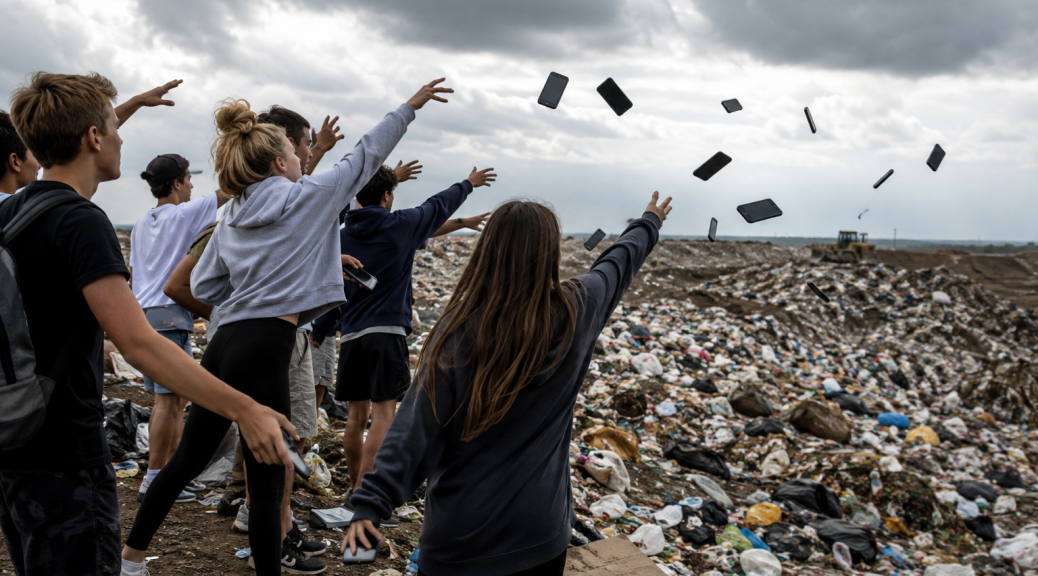
In Europe and New York, Silicon Valley and Scandinavia, banning phones and AI, dialing down technology is the counter-reformation that somehow inevitably had to follow the Promethean hubris of the tech explosion in classrooms. However, is it by removing access to these crutches that we will become wiser and more rounded? Is stopping, banning, reducing, curbing, and restricting going to make us more intelligent?
I don’t think so.
In this poetics of the negative, this reactionary mode, which smacks of panic, the important question to ask is not what we are not doing; it’s precisely what we are doing. My philosophy students have three major texts to read. How will I know that they have read them? When did I re-read them? I want to develop my students’ critical thinking, but how exactly will I do that? What is the relationship between the extension of my students’ long-term memory, the jogging and exercising of their short-term memory, the type of assessments I design, the quality of feedback and revision we engage in, and critical thinking?
In answering these questions, we come to a more affirmative stance, one that actually takes us back to traditional pedagogies, such as reading together in class, handwritten exercises, cold-calling and probing, looking through the notes that are taken, and insisting on comprehensive note-taking. It’s all been done before and a great teacher who wants the best for their students will do this before, during, and after AI (if there is an after AI!).
The exact same mindset should be taken to parenting: instead of concentrating on what not to do, what are we doing? When do we go for walks in nature together, when do we sit down to meals together and have extended discussions about the world around us? Do we read to our children at bedtime? Do we go over their work with them from time to time? Do we choose quality films and music to listen to together, go to museums and cultural activities? Do we pass on the knowledge and values we received from our parents to our children?
It is in answering these with the affirmative that we will break through the noise of AI and the dumbing down of the mind through artificial crutches.
If we do these things, if we seek what to do rather than what not to do, the way we use technology, and even how much we use it will become less relevant. If you’ve just finished reading some high-brow literature, and you spend some time scrolling, is that really a problem? The problem is when the scrolling eats up the space and time that could have been used for reading, and instead of reading, we scroll.
At the end of the day, whether it’s switching off in front of a television, procrastinating, spending hours on idle pleasures at the expense of those activities that will enrich us, asking someone else for the answer or getting someone else to do the work instead of us, or the modern version of these substitutions and distractions (which will essentially be through AI, but not because of AI, because we will have chosen that instead of the other route), the question is one of mental discipline and intention.
Let’s be demanding of ourselves and of our students and believe in their extraordinary capacity for critical thought by cutting through the doom and gloom, the noise and bites, with an affirmation of a good education, by acting on that, by forging out a path of thinking, creating, evaluating, acting, being and living.
(Photo by Zack Walker on Unsplash)