
In a world increasingly described as VUCA (volatile, uncertain, complex, and ambiguous), the question many parents ask is not simply What will my child learn? How will my child learn to navigate the world they inherit? A world they will inherit after decades of war with a lot of orphaned population; something that has become our reality especially with the recent war. Embittered, lost, hurt and dehumanized.
As a parent whose child has experienced the continuum of the Primary Years Programme (PYP) and the Middle Years Programme (MYP), I have come to appreciate that the value of education today lies far beyond grades and academic content. It lies in the competencies our children develop: the ability to ask thoughtful questions, adapt to change, navigate complexity, be resilient, listen to understand and collaborate across differences.
Recent research conducted by the Australian Council for Educational Research for the International Baccalaureate offers encouraging evidence. The study found that students in PYP and MYP schools outperform peers from non-IB schools on the International Schools’ Assessment across key areas such as reading, mathematics, science, and writing. These outcomes suggest that inquiry-based learning not only cultivates deeper thinking but also leads to strong academic performance.
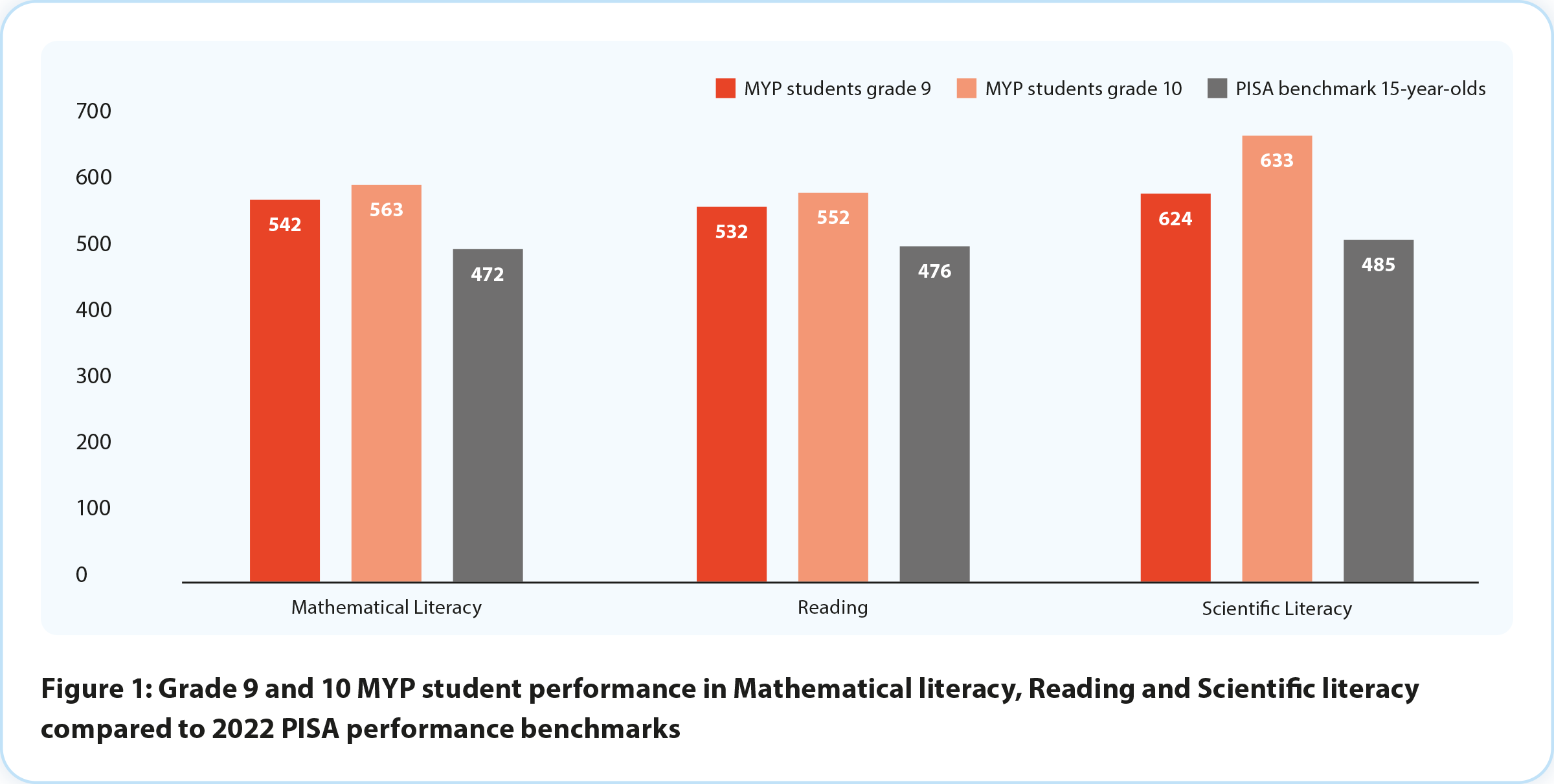
But as a parent, what strikes me most is not the benchmarks, it is the mindset these programmes nurture.
Learning to Think Critically in a Complex World
VUCA environments require individuals who can interpret information, evaluate perspectives, and make informed decisions. The PYP introduces this mindset early by encouraging children to question assumptions and explore multiple viewpoints through a transdisciplinary approach.
I have seen this firsthand when my child investigated environmental issues as part of a unit of inquiry on sustainability. For the sub topic of pollution he analyzed the causes, debated potential solutions, and reflected on how individual actions influence global outcomes. By the time he reached the MYP, these habits of mind deepened through interdisciplinary learning and research-based tasks that asked students to synthesize knowledge across subjects. This is what helped him in his DP (Diploma Programme) journey.
This kind of learning prepares students not simply to analyze complexity, a skill essential in a world where information is abundant but wisdom is scarce.
Building Resilience in an Uncertain World
If volatility defines our era, resilience must define our learners. In the PYP and MYP, learning is not framed as a linear path toward the “right answer.” Instead, students are encouraged to inquire, experiment, reflect, and iterate.
I have watched my child navigate moments of frustration during collaborative projects or extended inquiries, moments where the solution was not immediately clear. For example. math investigations in the MYP pushed him to think beyond formulas and look deeply into concepts rather than solutions. What stood out was the language teachers used: What did you observe from this? Where did you struggle with? What might you try differently next time?
These moments cultivate what might be the most valuable skill of all: the ability to embrace uncertainty without losing confidence and keep looking for solutions.
By the time students progress through the MYP, they become increasingly comfortable with open-ended challenges, projects that require sustained effort, research, and reflection. This experience builds the resilience needed to thrive in a rapidly changing world.
Developing Problem Solvers for a Conflict-Ridden World
Our world is also marked by tensions, political, environmental, and social. Preparing young people to engage constructively with these challenges requires more than knowledge; it requires empathy, collaboration, and ethical reasoning.
The IB continuum encourages learners to examine real-world issues from diverse perspectives. In classroom discussions, students explore global challenges such as climate change, migration, or cultural identity not as abstract concepts but as human stories requiring thoughtful solutions while valueing personal lived experiences
I have observed how students learn to disagree respectfully, justify their arguments with evidence, and remain open to new ideas. These are not just academic skills, they are ethical and civic competencies essential for navigating a pluralistic and often polarized world.
Beyond Benchmarks and Towards Preparing for Life
The research from the International Baccalaureate and ACER confirms that PYP and MYP students perform strongly on global benchmarks. Yet the deeper value of the continuum lies in something less easily measured.
-It lies in the curiosity sparked by a thoughtful question.
-It lies in the resilience built through a challenging project.
-It lies in the empathy developed when learners consider different perspectives beyond their own.
As a parent, these are the qualities I hope my child carries into his college experience and as a life long process.
In a VUCA world, knowledge will continue to evolve. But the ability to think critically, adapt confidently, and collaborate compassionately will remain timeless.
And that, perhaps, is the most meaningful outcome of all.