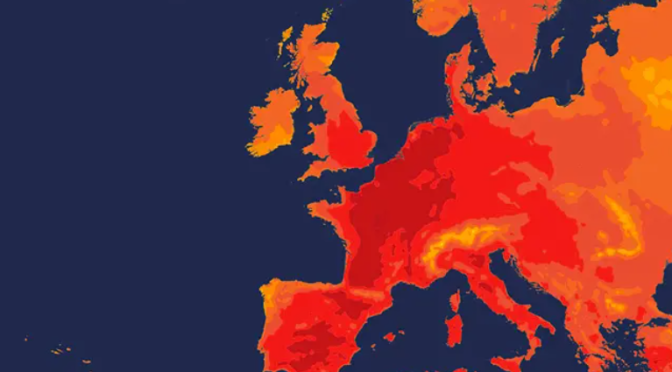
Europe is warming at a rate that is twice the global average. According to the European Commission’s Climate Action statistics, there were over 60,000 heat-related deaths in 2022 and over 47,000 in 2023 in Europe alone.
Recent summer heatwaves have exceeded 40°C (104°F) in the UK, France, and Spain, causing widespread drought and devastating wildfires.
It has become impossible to pretend that this climate deregulation is not a result of human activity. We are in the Anthropocene era and all the graphs and projections show it is getting worse quickly.
Over social media, many have criticized the European continent’s inability to deal with the heatwave because of a lack of infrastructural preparedness. Buildings and infrastructure are outdated in terms of insulation, passive cooling, or ventilation. Air conditioning is rare, which is understandable given the amount of energy it uses.
What is the lesson in all this for us educators?
While greening the curriculum tends to focus on individual behaviors and understandings that can reduce climate change, such as reducing our carbon footprint and understanding ecologically compatible ways of being, there are two other questions to consider.
Affect and Systems Thinking
First, the notion that the deeper route to greening the curriculum is through an affective approach, developing pedagogies that put learners in front of the beauty of nature and nurturing a love of nature within them. If we can develop this deep-seated love, we will surely be planting the seeds within young people that will drive ways of being that respect the ecosystem and care for it. Ways of doing this include field trips, outdoor learning, greening the campus and making the splendour of the wild express itself in the curriculum and the site.
Second, it is essential to teach a systems thinking approach to ecology: understanding how trade laws, markets and legislation have the overwhelmingly greatest impact on the climate. It is not by changing the consumer habits of each individual within an ecologically negative, plundering system, that real change will be activated. The whole system needs to be revised and this requires leadership, coordination and socioeconomic and political change. The teaching of economics, history, science and politics needs to take this into account, without turning the curriculum into an ideological proselytisation but at the same time ensuring that students are empowered to understand fully the complexities, externalities and interrelationships that define climate change and could help stop it.