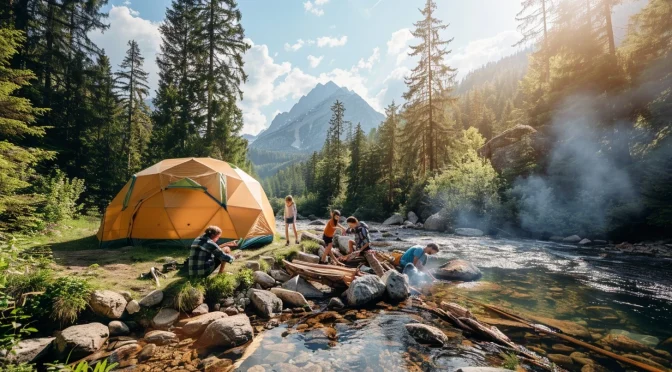
Millions look idly on, as the man builds a shelter. He cuts the wood. He ties the knots. He lights the fire with one strike of the steel. His sons are with him. The Alaskan river runs cold and clear. As a family, they will fish. Eat. Sleep on the dirt.
All the while, millions remain locked to their screens. Out of the elements.
Screens Don’t Build Shelters
Is there little difference between this and so many classrooms? The almost voyeuristic idleness and envy. Forget about all we might know about teaching, learning, and best practices. Throw out the window what may have been gleaned from Covid. The default seems to be students remaining fixed to a chair. Often passive as they either listen to teachers talk, or moreover, are told what to do! Little if any exploration or autonomy. Passengers, they even request permission to go to the washroom.
In both instances, watching a family camp and being in a traditional classroom, the wind does not touch them. The earth does not stain them. The water does not wet them. They merely sit and watch.
Luke Nichols’ Outdoor Boys is all too familiar in how it connects with education.
Outdoor Boys is considered one of the fastest growing channels on YouTube, gaining more than 5 million subscribers in a 12-month period. Nichols’ videos have more than 6.8 billion views! However, recently Nichols said he was hanging it up because fame can be “overwhelming.” He plans to spend more time with his family. His viewers? What will they turn to next? We need not worry. Voids are quickly filled.
Listening Is the Largest Slice
This past semester, I improvised at the start of a class and I asked students to draw a pie graph. Next, divide it up for how you see your average class and time spent practicing each of the following skills: listening, reading, writing, and speaking. Clearly there are so many other skills we are doing but for the sake of the exercise I just wanted to get a window into students’ perception. This was a big ask, as students have seven teachers. Yet, the overwhelming response is what readers might guess. Listening was the biggest slice of the pie!
Passively listening feeds a similar habit of simply sitting in front of screens. Clicking and swiping. Awaiting the next delivery of dopamine. We teachers may talk of engagement but are the children truly engaged? They consume.
Downloading as opposed to uploading.
Floating in still water instead of riding the rapids.
Watching others camp while in the confines of a couch.
They look on as Luke Nichols builds a boat of logs and tarps. Then sails it down a river with his sons. And they love it. Nichols’ sons but also our students. The big difference being that one is doing it! And more often than not, it is not our students. It isn’t our our students who by in large are building the boats. As I write this I can’t help but hear the words of David Goggins’ famous motivational mantra, “Who’s gonna carry the boats?” The phrase said to have its origins in how Navy SEALSs carry heavy boats over long distances.
Are students willing to make the boats? Carry them? If so, what might be standing in their way? I hope it is not I.
Let Them Feel the Cold Water
To think school is where the only learning happens would be a gross error. Years ago, 3 BIE (Before iPhone Era), I was part of a larger conversation about what school was preparing students for. Merely for the transition into university or on a grander scale, preparing them for life? And if the later, what might this mean? The question rings just as true today. Surely it is far more than slapping a diploma in a young adults’ hands. What are students able to do? And what could being cold teach them? Being a little hungry? So few students have ever tied a knot, lit a fire, or ever been lost.
To learn is not to watch. To learn is to do. To fail and try again. To feel the cold water and the burning sun. To fish and not catch. To pitch a tent, use the fly as a ground tarp and to be “swimming” in your sleeping bag. This is learning.
Building a boat and carrying it. This is learning. Not solely performing well on a standardized test.
Luke Nichols is authentic. He tells a good story and his passion and family values resonate with audiences. The natural world which viewers “experience” alongside him is also real. The creek is cold. The fish fight. The wood splits when you swing the axe right. Luke inspires connection, with nature, as a family. As well, what it might mean to embrace adventure.
What would a “creek-filled” curriculum look like? Educators, administrators, and parents please make room for the creek. Make room for the mud and the silence and the weight of real things. Let’s break out of the four walls that contribute to the falsity of learning being a controlled experiment. Let’s let the students build…and not just in Maker Spaces. Let’s let them fail.
Let’s let them live.
The alternative is that they will only ever watch.
| Want to dig in more? Here are seven examples of engaged students: St. Vrain Valley Schools – Innovation Center (Longmont, CO). Students collaborate with over 60 local tech companies on real-world projects, such as developing aquatic robots to study endangered species in Peru. They earn $10/hour while gaining practical experience in STEM fields Smyrna High School –Smyrna, Delaware, USA Engagement strategy: Six career pathway programs with internships and work-based learning to connect education to real jobs, increasing student motivation and engagement. Coleman Culinary at The Depot – Coleman Community Schools, MI High school students participate in a hands-on culinary arts program, transforming a former restaurant into a classroom where they learn baking, sanitation, and customer service, gaining practical experience through catering events and community dinners. High Tech High Chula Vista – Chula Vista, California, USA (browse projects) Engagement strategy: Project-based learning integrated school-wide, including extensive internships where students work 30+ hours weekly with local businesses. School of Environmental Studies (Apple Valley, MN)Known as the “Zoo School,” students participate in interdisciplinary, project-based learning with an environmental focus, including field studies and senior capstone projects that address real-world environmental issues. United World College of the Atlantic – Wales, UKSituated in a 12th-century castle, UWC Atlantic is part of the global United World Colleges network. The school combines academic rigor with experiential learning, offering courses in sustainability, peace studies, and global citizenship. Students engage in service projects and outdoor education, fostering leadership and a commitment to social responsibility World Economic Forum (WEF)Though a few years old, WEF selected 16 schools as models pioneering the future of education, reaching nearly 2.5 million children worldwide with new learning approaches. This is worth a read. |
##################