What did a year of Scandinavian studies teach me?

Image credit: https://www.needpix.com/photo/1689956/

I finished up my final report this morning, in which I describe the eleven courses I created for myself this past school year, all in the pursuit of learning more about Scandinavia. I proofed it quickly and then wrote at the bottom:

This final report is formally submitted, to myself, on May 21, 2026.

That’s right. I don’t have anyone else to turn it in to, since my role in this degree is student, teacher, dean, and abroad advisor. I’m the procurement guy, I’m the registrar, I’m it, period. I felt a bit like Kamala Harris when, in her role as Senate leader, she announced the flling of paperwork to fill her vacated Senate seat, reading her own name. She had a good chuckle. So too did I, this morning, as I realized that my report was going to nobody else but me.

To celebrate, I took the dog for a walk in the woods on a perfect Swiss spring morning. Dappled leaves, chattering birds, and a dirt path laced with tree roots that wound its way through the woods. The perfect time and place to reflect on what I learned. Below is a little of what I thought about (followed by the course). It’s a mix of content knowledge, pedagogy, and the big and small. The sort of thinking you do on a walk in the woods.

  • Written Danish, Norwegian, and Swedish are so alike you could call them dialects of Greater Scandinavian. There are probably other languages in the world that are much more distant from each other but that are still called dialects. In fact, linguists like to say that the difference between a dialect and a language is that a language has a navy and an army (language).
  • Apropos power, power and money is a prevalent theme throughout Scandinavian history, and to generalize, the history of people anywhere, anytime (history).
  • There are Scandinavian foods I can prepare well and others that I need more practice with. This isn’t the same as saying there are Scandinavian foods I like and Scandinavian foods I dislike, because a few times I think I nailed the recipe but didn’t enjoy the outcome much. Nor some of my family members and friends, just ask them about Flygande Jakob and rømmegrøt (cuisine).
  • The personality of a language teacher or speaking partner can be tremendously important to the learner. With some tutors I felt almost fluent in Swedish and at least communicative in Danish or Norwegian. With others I was absolutely tongue-tied. Same learner, same year of learning, different outcomes based on my speaking partner (languages).
  • The lives of Europeans settling in what is now Minnesota in the second half of the 19th century was exceedingly difficult. One walked for miles. One built their own house, starting with trees for the lucky. One hoped not to have a grievous accident during highly dangerous work. One hoped to get to Spring before starving in the Winter. The corollary: My life is extraordinarily cushy compared to all other centuries that humans have existed (Emigration to Minnesota).
  • As an autodidact, it is easier to maintain your motivation if you share your experience with other people. I don’t think I would have made it without making my project very visible to others (general).
  • But I did make it, so here’s proof that if you want to pursue an academic subject in depth, and if you don’t need the stamp of approval from an institution, (1) it is entirely possible and (2) it will cost you a fraction of the money (general).
  • It is the norm for political borders to change, for land to change hands, for the majority of people to be shoved around by the few in power. Not that it makes it right, but it is the story of Denmark and Sweden and the countries around them, expanding and receding, sometimes with breathtaking speed (history).
  • A good piece of fiction is chock-full of truth (literature).
  • Supporting adult learning has been a significant contributor to Scandinavian identity for over 150 years. It is something worth investing in no matter our cultural heritage: for individuals, groups, and regions (education).
  • Whatever I’m able to write down that I learned, I actually learned much more. Intangible things, things gained with growth and maturity that we can’t quite lay our fingers on (general).

While my final report is done, I still have the abroad requirement in front of me, one week each in Denmark and Sweden this coming summer. Then I’ll really be finished, even though I know full well I’ll continue learning language, reading literature, and even baking fresh cinnamon rolls now and again. 

I’ve decided I’ll do another year of self-study (in a new subject area), but this time with a group of colleagues who are also taking on self-study of their own. We aim to support each other, to validate each other’s experience, and to serve as soft external motivation for when the internal motivation slips. If you’d like to join us, let me know

Real professional growth: “No joke, it’s been life changing for me”

Experimental archeology with Travis Finneran

We’d like to think that the professional development we spend time and money on garners this enthusiastic a response much of the time:

“No joke, it’s been life changing for me.”

The fact that it doesn’t is a real problem. The fact that we are often stuck in patterns of telling and explaining, of talking at folks instead of with them, of assuming there’s been learning when there hasn’t been much, that’s a problem.

Professional development does not need to follow old models. Here’s what I experienced this morning, firsthand. An experience of joy, enthusiasm, respect, expertise, and collegiality.

Background

For over a decade, Leysin American School has invited teachers to suggest passion projects that extend across the academic year (and often beyond). Teachers with successful applications receive a stipend and some support from those of us leading professional learning. The actual time we spend on support is minimal. The most significant support is the message that we want teachers to experiment and that their self-directed work is worth doing and sharing.

This morning the faculty had a chance to attend two presentations among the eight that were offered, all led by teachers completing a year of self-directed professional learning. I heard project updates from Andie and Travis.

Outdoor education is education – Andie Flett

We’re about ten people, discussing the value of outdoor education, the why and some of the how. The presenter, Andie, is hitting the exact right tone for teaching adults: friendly, not taking herself too seriously, responsive. This is not a lecture, it is a series of structured discussions on a theme. 

This is the third time Andie has been what we call a “resident scholar” since the program began. She and a colleague explored homework support in the resident halls in 2014-2015 and student agency in the activity program in 2020-2021. This current school year she has created a curriculum for an outdoor education class as a regular part of course offerings. 

Our group talks about the importance of outdoor education from a variety of angles. Andie asks us, “What if we called our current academic classes ‘Indoor Education’ and we called outdoor education simply ‘Education?’’ The reframing makes us stop and think. What are our priorities? She asks us if it is okay to excuse students from academic classes for outdoor education experiences. Matt, an IB English teacher sitting next to me, says “of course” for his star students. For a struggling student, he hesitates. He names a student who is very focused on the outdoors but not very into Shakespeare. “Actually, who am I to say he should miss an outdoor activity for more Shakespeare, when outdoor activities are his passion, what he is good at?”

Right. In the twenty-five minute session we consider not just outdoor education, but differentiated learning and student choice and whole child development. Andie gets a chance to share her curriculum work with colleagues. We all get to observe an incredible example of non-teacher-fronted instruction. Everyone wins. And Andie knows we care about her and her interests. She matters.

Experimental archeology – Travis Finneran

The second session begins with a student playing the carnyx. The carnyx is a long horn, a bit like an alphorn, but the straight metal tube is held vertically, ending in the fanciful head of a dragon. The student can find various pitches, working the mouthpiece with an appropriate carnyx embouchure. Hatty, an English teacher, asks if it took him a long time to learn. “A very long time,” answers Travis, as he thanks the student and starts his presentation.

There are eight of us, sitting in a half circle around a table filled with jars and boxes and cloth and tree branches and rocks. And the carnyx and other stuff I can’t really identify. Travis, who is in his second year of introducing experimental archeology to the school, shares technologies with us from a time when this area of Central Europe was inhabited by the Celts. He talks about how the Romans died clothes, he lifts up bottles of dye made from berries, lichen, and other natural materials. He shows us ingots that he and students have smelted, making sure to share the safety measures he takes as well. He demonstrates how simple cutting tools were made by flintknapping, a process of hitting a stone with a hammerstone at the right angle to create a sharp-edge flint. Lithic reduction, it’s also called. 

Travis’ enthusiasm is infectious and we all ask questions and have some good laughs, especially when Travis, who likes to do things as they were done in the past (this is experimental archeology, after all) says that there are limits to sticking with ancient processes. The ammonium he uses, for example, does not come from the source it would have come from back in the middle ages, essentially aging urine. 

As teachers file out of the session, past the table of artifacts, Travis tells me he is considering getting a degree in a related field. These past two years of self-directed professional development have been “life changing, no joke.” 

The big takeaway

Professional development done right is an amazingly rich and meaningful experience, both for the learning of content and skills and for the sense of professionalism and self-efficacy that comes from sharing one’s continuous growth as an expert in a specific field. Almost universally teachers want to learn and grow and wonder and share with each other. If your professional development program struggles to build teachers up, to engage them, to offer a sense of intellectual wellness, well, build new models that do. 


For a list of the teacher-led projects since 2014, see Resident Scholars (www.las.ch/laser)

For more discussion of the promise of highly useful professional learning, see the work of Patrick Alexander (patrickgalexander.org/). We particularly like his conceptualization of “intellectual wellbeing.”

Contact Paul if you’d like to set up a similar program: [email protected]

When Work Lost Its Meaning

When did “work” get a bad name?

As summer in the northern hemisphere approaches, I’ve found myself in a number of conversations with parents of teenagers, particularly those who are recent high school graduates or home from college. A few phrases surface again and again: “He doesn’t listen to me anymore,” and “I wish she would get a job.”

They seem to point toward a shift in parenting that is different from the one I grew up with, and one I’ve recently heard described as “permissive parenting.” In this approach, parents often avoid conflict, set fewer boundaries, and sometimes give in to a child’s demands in an effort to maintain peace. Some even suggest that parents feel intimidated by their own children.

This sits in contrast to how things felt more traditional, where what parents said carried real weight. You didn’t really question it. You just accepted it. That was the world I grew up in: babysitting, mowing lawns, shoveling snow, and working forklift jobs in the summer.

What Work Taught Me

Looking back, what stands out most from that early work is not the tasks themselves, but what they required of me.

Above all, I learned how to show up.

There were days that were physically demanding. Heat that scorched, and also frozen days. Early mornings and nights that stretched longer than expected. But within that rhythm, I began to understand initiative. I learned something about discipline, and I began to connect effort with value. In that sense, work was not only about earning money. It was also about learning what it means to contribute. It makes me wonder whether handing a child a credit card, while struggling to say “no,” serves them well for what lies ahead.

The Saturday Morning That Didn’t Match the Story

And yet, things are not always as they first appear.

I was reminded of this recently when a grade 12 student surprised me at 7am on Saturday morning. Wanting to be sure I understood what I was seeing, I later checked her attendance record. On paper, she is what might be described as a “part-time” student, skipping on average a class each day. “Skipping” may not even be the right word,” given that many of these absences are excused by a parent (a topic I’ve written about before in “Breaking the Habit of Excuse”).

And yet, on this particular Saturday morning there she was!  Greeting me, taking my coffee order, and working the cash register. Meanwhile, it felt reasonable to assume many of her classmates were still asleep. Curious about this contrast, I learned that her family does not struggle to make ends meet, yet both parents themselves are hard-working. It brought to mind the familiar saying about the apple and the tree. I guess I should not have been surprised. 

Learning Through Everyday Responsibility

Another recent moment that is staying with me came during a dinner out. A family, two young parents and their toddler and baby dined at the table next to ours. The toddler did not have the phone of mom or dad in front of him, to hold his attention. He simply watched the room. His younger brother doing nearly the same, except for at one point crumpling a paper placemat in quiet exploration.

When the food arrived, it was not from a children’s menu. The parents cut portions and placed them in front of both children, and then simply allowed them to eat. Meanwhile they carried on their conversation. This “ritual” was not performative, rather seemingly instinctual. There was no coaxing or coddling. If the children were hungry, they would eat. It was beautiful. Unmanaged and natural. 

The Lawn, the Robot, and the Missing Lessons

On another day,  it seemed my neighbor and I were synched as we moved about mowing and trimming our lawns. At one point we paused in unison and exchanged niceties. I said something in regards to how he soon was likely to be unemployed from lawn duty and how his son would soon take over. He responded how he imagines a robot doing the work. Oddly enough, one of my favorite weekly bloggers, Nathan Krai, recently wrote about a robotic lawn mower. How “it maps the yard. Cuts the grass. Charges itself. Goes back out. No effort. No time required.” The post is titled, “The Trade We’re Not Talking About.” Krai compels us to consider optimization and at what costs. Talking with my neighbor, I couldn’t help but think how getting such a robot would not only be cutting grass. It would be cutting his son out of the opportunity to learn so many things. Responsibility and how regular tasks need to be completed even when they may feel repetitive. Work ethic and a connection between effort and visible results. Delayed gratification or simply the feeling of contributing to the family. And care, maintaining a lawn teaches stewardship and respect for the home. And yet, as Krai alludes to, it may not even be about the “work” but more about optimization and the need for conscious decisions as we move into the possibility of more automated tasks in the futures. 

Finding Balance in Parenting and Teaching

Children grow through work, responsibility, and expectations, yet it is also true that an overly permissive approach can limit the kinds of experiences that shape them. At the same time, there is a need for balance. Knowing when to step forward, and when to step back. As a teacher of Capstone, I often feel this as a kind of quiet tension. Part Science, part Art. And yet, not always equal parts. 

This year, I experienced that tension with a student I will call Kyle. From the outset, it was clear that a conventional approach would not serve him well. His previous year had been marked by disengagement and avoidance, and his attendance reflected that reality. Instead of insisting on constant structure, I stepped back more than I normally would. Over time, something shifted. Kyle began to build his own project, ultimately learning to vibecode an app that was later published to the Apple Store. It was not a straightforward process. There were misunderstandings along the way, including concerns from some that he was “cheating” by using AI. But what I observed was something different. Kyle’s engagement was sustained and he showcased the value of iteration. His persistence was evident in consistent trial and error. When he presented his work to the community, there was a clear sense of accomplishment. More importantly, there was ownership.

Three Things Worth Holding Onto

As the academic term comes to a close, I find myself returning to three simple reflections:

  • Teens benefit from summer jobs.
  • Robots should not be cutting our grass.
  • And in both parenting and teaching, we are often called to move between stepping forward and stepping back.

And as far as “work” getting a bad name, it seems some cultures, and perhaps classes, have mistaken comfort for success. Avoiding the very effort and discomfort that build capable people.

##########

From Screen Time to Mindful Time: Reimagining Tech in the Classroom 

The EdTech revolution that swept over classrooms some 20 years ago was a wave of uncritical implementation: whiteboards, cloud-based learning platforms, and 1:1 computing programmes unfurled in a tidal wave of widespread technology adoption with each school following the next eagerly.

There were always those anecdotes that threw up questions: was it true that the CEOs of the very same companies selling software and hardware to schools were sending their children to pen-and-paper institutions? Somewhere in the school community, you would find voices that stood up to questions of data privacy, but these were the exceptions that proved the rule. The essential idea was to go with the flow, which is what most schools did, and the intensification of networks, fiber optic cables, chargers, leasing agreements, charging trays, and the maintenance to supply this, proliferated exponentially. 

This has led us to a highly synthetic classroom environment: it’s possible to see students learning in an entirely paperless environment. Lessons are projected on a whiteboard and homework is done on cloud computing; we navigate learning from one screen to the next. And at break time and after school? Well, out come more screens of course: phones.

More recently, a different type of wave is rising above classrooms, one that calls for a dialling back on screens. From Anna Lembke’s Dopamine Nation (2021) to Jonathan Haidt’s The Anxious Generation (2024), more and more voices are asking for schools to reconsider technology, in particular phones and screens. There are worrying correlations in the steepening drop of IQ scores (particularly from 2010) and, with the explosion of Artificial Intelligence on the market, the dangers of cognitive offsetting and deficit due to Large Language Models being available to replace research.

At the center of this is the feeling that we need to regain the community connection between us that is now spliced into separate, individual profiles, isolated yet simultaneously hypnotised by chemically stressed layers of carbon polymers, liquid crystals and rare-earth elements. It takes a concerned effort now to pull us away from screens, to shut them down, to appreciate each other rather than whatever’s happening elsewhere in the tiny prism of light held in the hand or propped up on the desk.  It’s got to the point where parents of a certain generation are nostalgic about watching television, which is somewhat depressing considering the virtues of the couch potato and how watching TV was viewed as a waste of time by many back in the 1980s.

We’ve reached something of a perfect storm with an increasingly widespread consternation that technology is not actually helping learning but getting in the way of it.

Of course, it’s much more subtle than this: AI tutors, adaptive online assessments, online courses, and the democratisation of knowledge through the internet mean that in many areas, learning has never been this available. It is also true that through COVID-19, and today in certain rural educational programmes, literacy rates have increased dramatically because of technology. It remains a double-edged sword, a two-sided coin, a Pandora’s Box with hope lurking inside it.

As educators, the question we should be asking ourselves today is a simple one: how is our use of technology advancing learning? Rather than giving assignments on cloud computing as a reflex, stop to ask why and whether it wouldn’t be better to ask the students to handwrite in the classroom? Rather than rushing to the next PowerPoint presentation or whiteboard lesson, stop to think whether it might not be better in an analogic setting, through a discussion, without screens. Given what we know about the cognitive benefits of reading and writing, how are we as educators ensuring that these practices remain strong in the classroom?

At the International School of Los Angeles, we have laid out our position starting next year. It’s in four parts:

  1. We will be phone-free right the way through the school.
  2. The 1:1 programme will be staggered, starting in the Middle School with a “computer at school only” policy, then computers at home but with a curfew (we will programme the computers to black out at 21h00). Seniors use computers as before, but we will have scaffolded the way there.
  3. A very specific AI programme on tutoring in one subject using a protected semantic field (not the World Wide Web) carefully curated by a resident specialist with an opt-out possibility for parents. This sits over our school AI policy.
  4. A special course on social media for our students for them to understand the way information is distributed and curated.

We will track this carefully and, most importantly, accompany it by discussions and training with our faculty on how to use technology intentionally, with a sense of genuine innovation, but also trepidation and skepticism.

What will your approach to technology be next academic year? 

Works Cited

Haidt, J. (2024). The anxious generation: How the great rewiring of childhood is causing an epidemic of mental illness. Penguin Press.

Lembke, A. (2021). Dopamine nation: Finding balance in the age of indulgence. Dutton.

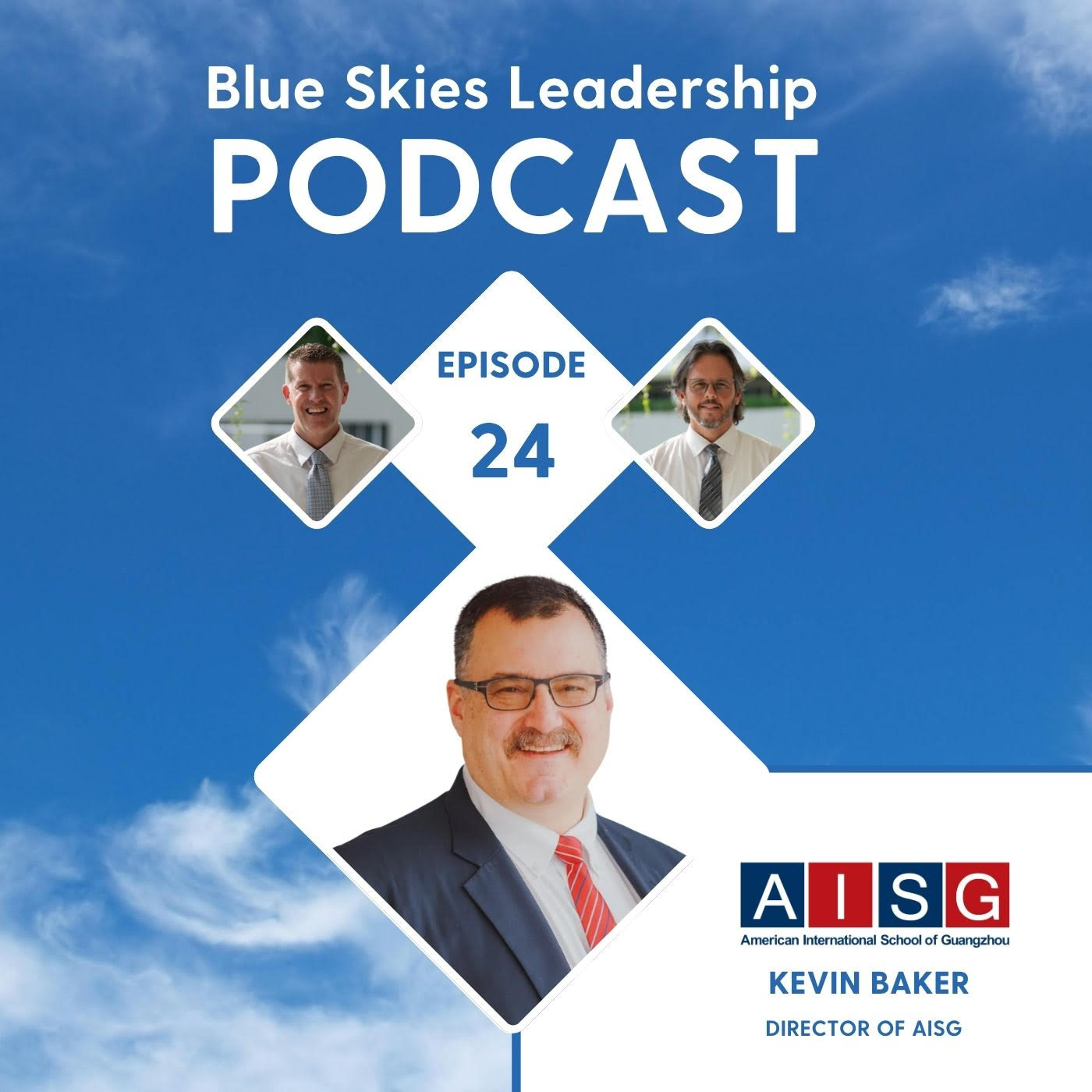
Blue Skies Leadership Podcast – Episode #21

Connection before content. It’s a simple phrase that changes everything about how we lead.

Episode 21 of the Blue Skies Leadership Podcast is LIVE! 🎙️

Today, Daniel Mendes and I sit down with international school teacher and change expert Nick Haywood to discuss why the most effective leaders prioritize relationships over results to actually get better results.

In this episode, we dive into:
-The “CHanGe” framework (and the touching story behind the name).
-Why managing your energy is more important than managing your calendar.
-Practical rituals like “See, Smile, Spud” to build instant belonging.

Nick’s insights from the worlds of elite sports and international education are the “needle movers” every leader needs right now.

Listen to the full episode here: https://lnkd.in/d7PmMzW7

#BlueSkiesLeadership#InternationalSchools#LeadershipDevelopment#ConnectionBeforeContent#NewEpisode

Lessons from the Redwoods

In the Reggio Emilia approach, we say that the classroom is the third teacher, which is why we spend the time we do curating an aesthetic, pedagogical and ergonomic space for learning. To me, nature is by far the greatest classroom as it has an immediately pleasant and welcoming effect on the senses. I have very fond memories of an English teacher in Eswatini who would teach us poetry on a lawn, something I later did with my own students in India. I always encourage colleagues to go outside with their students for some fresh air in the outdoor breeze. It’s something my colleagues do at the International School of Los Angeles quite a bit. Seeing our students writing and reading in the dappled shade of acacias is mindful, especially in this day and age of heavy screen use, artificial light and devices.

While some natural settings are sufficiently bucolic to serve as a backdrop for learning something else, others have a real presence, and are a different type of classroom altogether.

Not long ago, I had the privilege to find myself in a redwood forest in Big Sur, some hundred miles south of San Francisco. Several of the trees stand over 200 feet tall and, astonishingly, are over 1,000 years old. The rich, scented bark is a protection against fire and the canopy so high above creates a mysterious, soft microclimate below. Walking deftly among these prehistoric giants is a lesson in and of itself. Rather than cogitate and project, the mind absorbs and appreciates; rather than processing information and thinking, your whole being simply is.

I think that’s because the sheer magnitude and beauty of the trees, their protective and magnanimous presence overpowers you and is nothing of the blank page or under-stimulating background that a classroom tries to be, it’s a living presence that makes you feel a tremendous sense of humility and gratitude to be alive and to share such a moment. You are swept up by it entirely. Little wonder that so many have seen and continue to see such spaces as sacred.

The redwoods are not a classroom for maths, languages, humanities or even sciences and geography, they are a lesson in being, that mysterious and miraculous thread that binds us all while we are here on earth. The effect of such an experience goes beyond learning; it is a type of deep cleansing of the psyche. Long may the redwoods last and may humans continue to have the wisdom to respect them and leave them to grow, to give, to be.

GLOBAL BOOK RECOMMENDATIONS

Global books for global kids – the following brand new titles allow readers to read a variety of viewpoints about people in different cultures.

InA Single Dreadlock, written by Xaiver Michael Campbell, illustrated by Eugenie Fernandes, Lovie was always the same as the other kids in Jamaica. But now that he lives in Newfoundland, he looks different. Especially his hair. Lovie misses his grandma who would smooth his hair down and braid it, something his dads can’t do properly. And when he gets teased in class, he really misses his grandma. As a surprise, she shows up at Channukah time! With jars of hair grease and a whole lot of love and wisdom that help Lovie to be proud of his dreadlocks.

Groundwood Books, ISBN 978-1-77306-938-8

The Sunshine Project is Uma Krishnaswami’s newest title in the Book Uncle trilogy. Set in India, three best friends are assigned school projects. But they have to work with different students from their class. While delving deeper into the city’s commitment to building a new factory to produce solar panels, they discover that it is not as positive as you might think. A coastal village and wilderness area are threatened by the factory. The children involve everyone in their neighborhood, making new friends along the way, and work hard to convince the mayor that there are better ways to accomplish his goals. Weaving in family, sports and every day settings, this is a fun story for young readers.

ISBN 978-1-77946-053-0, Groundwood Books

Words Matter by Anita Fitch Pazner, with art by Sophie Casson is a small but incredibly important book for today. The subtitle is The Story of Hans and Sophie Scholl and the White Rose Resistance. This deceptively simple story tells us of the beginning Nazi movement in Germany, where a financial depression leaves people desperate for a new, dynamic leader. But Hitler uses freedom of speech to spread lies and make the people afraid – afraid of those who are different from themselves. 

At first Hans and Sophie are excited to join a youth movement. But soon, their upbringing of sharing ideas and reading many books, leads them to see the truth. 

The book uses a powerful refrain throughout the story to show the importance of words. When books get burned, people will follow. And so Hans and Sophie have to make a choice – to do what is wrong or to stand up for what is right.

A fabulous, and important, book to help readers of all ages understand the past and navigate the future. 72 pages, labeled ages 9-12.

Groundwood Books, ISBN 978-1-77306-970-8

Gandhi, a Manga Biography by Kazuki Ebine.

Through his quietly powerful leadership and influential use of nonviolent resistance in India’s struggle against the British Raj, Mahatma Gandhi became one of the most revered figures of the modern era. While history has recorded Gandhi’s words and deeds, the man himself has been eclipsed by maxims of virtuosity that seem to have little resonance in our everyday lives. In Gandhi, the third volume in our exciting new manga biography series, created in conjunction with Emotional Content, Kazuki Ebine combines a gripping narrative with stunning illustrations to share Gandhi’s inspiring and deeply human story with a whole new generation of readers. Developed in conjunction with Emotional Content.

ISBN 978-0143120247, Penguin Books

Careful What You Wish for by Mahtab Narsimhan is the perfect high interest, low vocabulary novel for tech savvy teens. Eshana does not have much of a social life. While she does have one best friend, she is envious of girls who hang out together in groups. And, even though her parents and computer class teacher have warned her about visiting unknown websites, she is attracted to a wonderful looking site that draws her in with a fairy tale setting and the promise of wishes come true. 

And what else would she wish for than friends, no more school bully and money?! Little did Eashana realize that her wishes would come at a cost. Too high a cost. Will she be able to break the spell cast online? And will she be better off in the end? A gripping read for middle school.

ISBN 978-1-4598-3400-2, Orca Books

Margriet Ruurs is the author of many books for children. She is available for author visits and writing workshops at International Schools: www.margrietruurs.com

Against Empathy

I have been very much struck by one of the most powerful and counter-intuitive but compelling books that I have come across in a long time. Paul Bloom’s Against Empathy seems to suggest a ridiculous idea; how can empathy be a bad thing? But the sub-title The Case for Rational Compassion raises the nuance of emotional response, and I think he raises some very easily misunderstood issues.

Bloom defines empathy as the ability to feel to some degree what others are feeling; and he notes how many have argued that this is at the root of moral behaviour – indeed, how lack of empathy is at the root of many evils. He notes that empathy has a lot going for it: “One of the best arguments in favour of empathy is that it makes you kinder to the person you are empathizing with”. Lab experiment bear this out – but as Bloom points out, lab experiments are by their nature short-term, immediate and constructed. The real world is so different to the lab – and this is Bloom’s argument – that the effects of empathy in the real world are completely different; so much so that empathy actually erodes rather than supports the behaviours we would want to see. For me, this was initially hard to swallow – but Bloom gives plenty of examples.

We often feel empathy for children – and we know that this empathy can motivate real concern and action. Many orphanages around the world have been the beneficiaries of this concern. But the effect here has not always been what we would hope – and longer term, Bloom argue that empathy has enabled the creation of an tourist-orphanage industry and created pressure on poor parents to put their children into orphanages – often to make money for the ‘orphanage’ owner. Another example is giving money to child beggars. I have done it myself after my heart was tugged by the dirty ragamuffin carrying his baby brother and asking for a dollar. But by allowing myself to be swayed by my empathy, was I perpetuating his time as a beggar? Was I inadvertently giving him and his family a strong incentive for him to remain on the streets rather than get an education? Worse still, might I even have been contributing to the well-documented cases of gangs kidnapping children to create more beggars? Perhaps, in fact giving money was one of the worst things I could possibly have done for this child. Never mind my motivation; what was my impact? (TED talk on this topic)

This is tough stuff to read, as it holds up a mirror that is not always comfortable to look in. What is boils down to is that our good intentions, our deep empathy, our commitment to care, are not by themselves enough to make a better world. They are starting points but they must be combined with careful and critical attention, and while empathy can – must? – be a motivator, sometimes we get to better solutions if we can strip out the raw emotion. But don’t just take Bloom’s word for it – Ou Virak (@ouvirak), President of the Cambodian Center for Human Rights in Phnom Penh writes “Cambodia needs to get out of the beggar mentality. And foreigners need to stop reacting to pure emotion.

Bloom is with Virak here, and he powerfully draws on his own experience of parenthood to make what was for me a compelling point; that while our empathy for our own individual children is natural, the very depth of that very specific and highly directed empathy can blunt our feelings for others. In what is perhaps a troublingly honest passage – at least for me – Bloom writes that “hearing that my own child has been slightly harmed is far more moving to me than hearing about the horrific death of thousands.” Parents, if we are honest, we know this is true. And his point is that our empathy naturally falls on those closest to us – relatives, friends, those like us, perhaps of the same nationality, race, gender, sexuality, tribe… in other words (and he runs through the evidence here) empathy actually opens us up to biases that are better left behind in civilised society. Now, none of this is to deny the important of family, but as Bloom acknowledges, anyone dealing with anyone outside immediate close circles cannot afford to indulge the natural biases to look after our own; to do so “would be fine…for a father, but… terrible… for a policy maker” and a poor moral guide to shape social choices. Looking around the world today, where this seems to be a driver of far-right behaviour, surely, this is wisdom that we need to pass on to our children and students.

If Bloom stopped there, this would be a valuable book. But he goes on further, and it’s hard not to go with him. Having dismantled the role of empathy at a policy level, he also eviscerates it at some professional levels. His basic point is a familiar one; that professions are rational at root – even (especially?) those involving high emotions. Anyone who think it is important for an empathic therapist to feel anxious or depressed while dealing with anxious or depressed people is missing the point of therapy. While it is quite possible that some prior experience of mental illness would enrich the therapist’s insights (which Bloom would say is compassion), for therapists to empathetically experience the maelstrom of depression when meeting patients would grievously impair their ability to help. So also for a doctor, teacher or parent. Bloom writes that “my worst moments as a father are not when I do not empathise; they are those when I empathise too much and cannot disengage from my children’s emotions to give them what they need – even when they do not realise it themselves.” Any parent knows this – we need people who counterbalance our emotional states, rather than dive right in with us. We need those who care about us to meet our panic with calm and our gloom with good cheer.

We do not need empathy to act. When my baby is scared of thunderstorms but I am not, I can understand her fear though I do not feel it myself. When my students are stressed, I understand why, even though I know it will be OK. That doesn’t mean I don’t care; it means I have rational compassion – not empathy. And it means I am better able to help than if I am in emotional turmoil myself. Compassion is feeling for and not feeling with and if Bloom is right, we should cherish it more than the easy and obvious empathy.

I have taken a while to get here, as Bloom’s claim is so counter-intuitive. But I think he is right; and furthermore, I believe he has helped me better understand some issues that I have been thinking about for a long time – for example, why Service is about so much more than just raising money and ‘doing good’ and also Why Critical Thinking is central to proper Moral Thinking. So there are immediate and practical applications of these ideas, and they can inform thinking in schools – and much further afield – on a daily basis.

This is not just a beautifully written, funny and moving book. Nor is it simply the application of deep thought to reach a surprising conclusion, or even a masterpiece of profound ideas packaged in a deceptively simple manner. More than that, this is an important book to anyone interested in making a better world – and all the more so as it jolts us out of our usual views, and nudges us towards deeper understandings. Bloom may not be entirely right (I have a hunch that empathy is the pre-cursor to compassion for example) but looking for cracks in his argument is a reward in itself.

References

  • Bloom, P. (2016) Against Empathy: The Case for Rational Compassion. Ecco Books.

Blue Skies Leadership Podcast – Episode #22

Leadership isn’t about having a perfect plan; it’s about having the courage to make the next best decision when the ground is shifting beneath you.

Eight weeks ago, Daniel Mendes was evacuated with his family from Doha while trying to support teachers and students during an escalating international conflict. In our latest episode of the Blue Skies Leadership Podcast, my co-host Daniel Mendes and I sit down for a raw conversation about what happens when “leadership theory” becomes your literal reality.
The hardest lesson learned: You have to give yourself permission not to be perfect. You will make mistakes when the environment is volatile. The goal isn’t a flawless execution; it’s providing coherence for your community.
We have postponed releasing this episode (Daniel M. now back in Doha) because of the emotional toll it has taken on Daniel, his family, and their community. We’re sharing this now because we want to give other leaders permission to be human.

Listen to Episode 22: https://lnkd.in/d68CqfyJ

#BlueSkiesLeadership#CrisisLeadership#IntlEd#VulnerabilityInLeadership

Creating your own MSelf or SelfCert

I’m smiling as I write this because I’ve now written these two recent additions to my vocabulary enough times that they feel sort of real. It’s sort of cool how you can create new stuff if you just, well, create it.

And I think that’s going to be the basic message here for how to go about creating an MSelf or a SelfCert. It’s so wide open that you can just create what you would like to create, really, and after you have some sort of idea what you are going to do, whether it is vague or detailed or anywhere in between, you just start doing it. It will take you somewhere where you can adjust and continue on …

This is just my experience. It’s not a prescription to follow, but rather an example to try on, like a pair of shoes. 

My first MSelf

I don’t know when my first MSelf / SelfCert was and you won’t either. We all learn lots of stuff in different ways. In high school I focused on tennis, I tried my hand at Nicaraguan liberation theology and sewing in college, I did poetry for several years after university and got more and more interested in languages, which I’ve worked with off and on ever since. I’ve been working on creative writing now for several years, too. There’s so much that we just go and learn out of interest and curiosity.

In Summer 2025 I decided to dedicate a year to Scandinavian Studies, which I’ve been interested in for a long time, particularly since the summer before my senior year of college, when I took a course in German at the University of Minnesota. In Folwell Hall there was a sign for the department of Scandinavian Studies and Dutch, I think it was called. Now I see they have the Department of German, Nordic, Slavic, and Dutch. Nearly forty years later I thought I’d give the Nordic part of that long department name a whirl.

I came home from a dog walk in mid July determined to look at Scandinavian Studies programs. I scanned through three of them: my alma mater, the University of Minnesota, and the University of Wisconsin and Berkeley. I spent maybe an hour, hour-and-a-half. I had already thought about what I would like to do一 I was basically verifying that what I had in mind might belong to a Masters program. Since the MEd program I teach in lasts just one year, I decided one year would be long enough for an MSelf, and since I really liked the structure of my undergraduate program at St. Olaf College in Minnesota, I decided to have four-and-a-half fall semester courses, a January course (we called it Interim), and four-and-a-half spring semester courses, followed by a short abroad experience.

I drew boxes in three columns (fall, January, and spring) and wrote the names of the courses. For the fall semester I chose Scandinavian languages (two credits), literature (1 credit), the folk high school system of adult education (1 credit) and Scandinavian cuisine (half a credit). For the January term I decided to focus on immigration to Minnesota (of which I’m a product, a few generations removed), and for the spring semester I kept the languages (2 credits), literature (1 credit), and cuisine (half credit), but replaced education with politics, which I eventually switched to history about a week before the second semester began. In the second semester I also focused on Swedish, since I had decided to take a Swedish writing course as part of my abroad experience, so I replaced the second language credit with a course in creative writing in Swedish.

The abroad program was simply three weeks in Scandinavia. I figured I would live one week in each of the three largest Scandinavian countries. I discovered I could live at a folk high school in Sweden and be a writer for a week. A friend suggested I visit the open air museum in Roskilde, Denmark, so I rented a nearby Airbnb. And then a colleague in Iceland invited me to come to Reykjavik in the fall as a visiting scholar. A little later than my original plan, but hey – it is so perfect. 

Curriculum? For languages I was already using Duolingo and iTalki. I added online subscriptions to a Danish and Swedish newspaper and committed to reading some of the texts in both the literature and immigration courses in Scandinavian languages. (I followed through, reading in both Danish and Swedish. Norwegian, I’ll get to you eventually.) I watched a few Netflix shows in Scandinavian languages. Luckily the course about folk high school programs steered me to  free online Swedish courses and inexpensive online writing courses. I also reconnected with Barbara Cartford, who tutors Swedish online, and we’ve been having fun language meetups ever since.

I googled what literature was considered part of what someone should know about and I asked my language tutors on iTalki and at the folk high school what they read in school in their countries. I bought a Kindle for immediate gratification and portability and I discovered Bokus to order regular books in Swedish. I also got a few texts in Danish from Orell Füssli in Switzerland. There is also a fantastic online site with free Swedish texts: Literatturbanken.

I didn’t know at the beginning where my reading would lead me, nor that I would eventually focus on Swedish. (I actually took placement tests in Danish, Norwegian, and Swedish before and after the first semester – also free from a Swedish folk high school. At the beginning of the year I was better at reading Danish than Swedish. That has since flipped.) I didn’t know that I would sign up for an online course in Scandinavian bildung, but it fit very well with the folk high school work. And I had no idea I’d be able to do a weeklong writer’s course in Skölding, Sweden in the summer, but yes, anyone can sign up, from anywhere in the world.

I also didn’t know I’d have a shield with a Viking ship and Old Norse as a symbol for my MSelf, but I made one, so now I have one. And this afternoon I made a symbol for my SelfCerts 2026-2027, too. It’s just one symbol, perhaps I’ll add the month … or perhaps I’ll just give myself as many of them as I actually accomplish.

In summary, I planned in a very general way; I created a framework. And then I let the learning take me where it led. I was successful not because of the specifics created beforehand, but rather the flexibility of following where things led as they emerged from the learning itself. That flexibility is perhaps one of the important distinctions and advantages of an MSelf: the curriculum fit me very well because I kept creating it as I learned. I didn’t know I would be able to read Swedish crime stories, but once I read one it seemed logical to read several. I had never heard of Johan Hassan Khemiri, but the first novel was so good I read a second (which a student in one of the writing classes recommended). Same thing for Tove Ditlivsen, only that was a trilogy and I read it in my strongest second language, German. Oh, and while I loved the Swedish poetry class, the other writing class? I paid to attend ten times, but quit in the middle of the third session, with a polite but final “I’m sorry, I have to go” message in the chat. The teaching didn’t fit my level or my expectations, and it was in English. So I dropped the class. Easy as that. Leaving the class didn’t harm my learning, it improved it, because I was able to focus on more productive avenues.

That’s how I planned my MSelf. I created a framework. I followed my interests. I added and subtracted as I went with an eye toward motivation, effectiveness, and enjoyment.

Oh, and one other thing. I blogged about the process along the way and I shared with people what I was doing. Going public was important. I even picked up the book “Little Experiments” during the second semester, which underscored how being public about your self-learning keeps you accountable and motivated. The book is pretty much a handbook for anyone interested in creating an MSelf or SelfCert.

That was my personal formula. It’s just one formula. It’s only an example.

Moving foward with a SelfCert

In Fall 2025, after posting about my MSelf progress (that whole going public thing), I connected with Irina, who was among the first to express interest in doing something similar but a bit less intense. We created the SelfCert on the spot. The SelfCert is virtually the same as an MSelf except for the duration. SelfCerts are shorter. How much shorter is up to every individual person creating a SelfCert. That’s part of the joy of it being self-directed.

For my part, I’m planning in 2026-2027 to do a series of SelfCerts. They will be thematically linked around the theme of health and nutrition, an area I’m committed to more out of necessity than a burning interest. This will be much different for me than a year of Scandinavian Studies. I’m making little bets by keeping each SelfCert independent and only three weeks long – the first three weeks of the month. During each three-week time frame I will focus on one modification to my current eating habits and one type of physical activity. How I feel will be my main assessment.

If the three-week period goes well I will perhaps extend the practice longer, combining it with the next SelfCert. If I’m ambitious I’ll do one SelfCert every month, September through May. Considered all together, that will almost be an MSelf, I suppose. But I’m not committing to that. I may take a month or two off. I may or may not create a Healthy Cooking component like my two half-credit Scandinavian Cuisines courses. I’m keeping it at the SelfCert level because (1) I know my motivation is more pragmatic than passionate and (2) I’d like to experience a SelfCert in order to be a better coordinator of both the MSelf and the SelfCert for others who will join me in the pursuit of their own interests.

And what are those interests, you ask? Are there really others who want to join? Well, yes, I’m glad to report! Those who have already picked a 2026-2027 topic are interested in pursuing:

  • Agentic AI in Education
  • Creating Textiles
  • Creative Writing
  • The Language and Culture of Bolivia
  • Photography
  • Shedding Light on Dark History
  • Using AI tools for business analysis and integrating AI solutions in business environments.

If you’d like to join us, let me know. I think it’s going to be a hoot! We plan on meeting online once a month to swap stories and motivate each other. Reach me at [email protected].

Sharing stories, expertise, and experiences from international educators around the world. In the spirit of amplifying diverse voices. TIE's blog space is not subject to editorial oversight. TIE bloggers have a long history in various aspects of international education and share their thoughts and insights based on personal experiences.