Did you know that over 80% of international school headships end prematurely? Leadership instability isn’t rare, it’s a systemic epidemic across our sector.
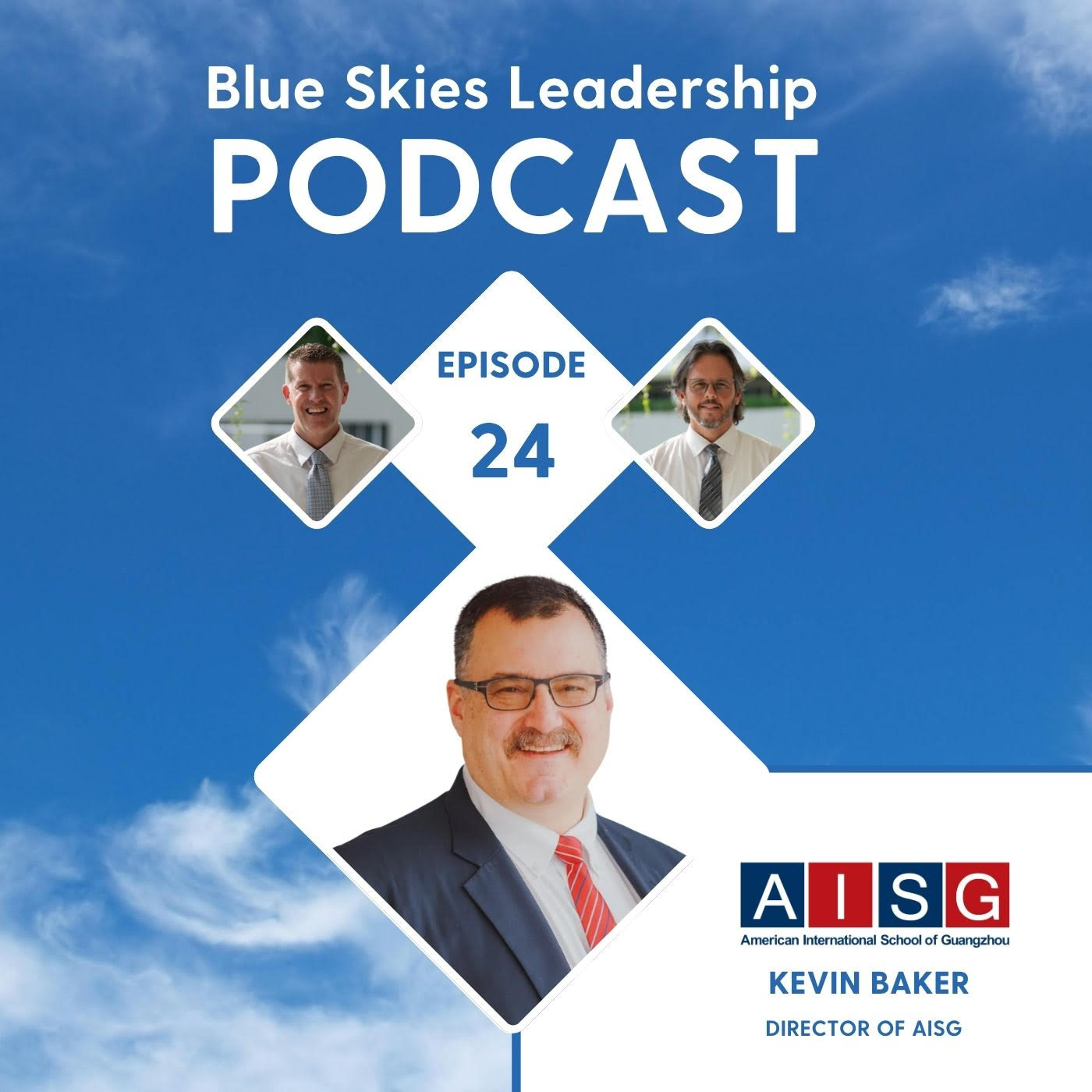
Episode 24 of the Blue Skies Leadership Podcast is officially LIVE! In this episode, hosts Dan Mendes and I sit down with Kevin Baker, Director of the American International School of Guangzhou , to discuss his groundbreaking research-backed white paper on leadership transitions.
Kevin challenges the classic myth of the “90-day transition” and argues that a successful transition is actually a two-year process that starts the moment the contract is signed. This conversation is an absolute masterclass for any international school head, board member, or aspiring leader committed to school stability.
I remember the public information films of the 1970s and 80s, when nuclear annihilation was treated as a practical household problem. We were told Stay indoors. Close your curtains. Place yourself under a table. The assumption that after a thermonuclear exchange, you’d want to get the curtains right was presented without irony. We lived with that terrifying background hum for decades. Thankfully the worst-case scenario didn’t materialise; not because it couldn’t, but because human beings made good choices that prevented it.
That memory came back to me this month, reading two articles that have been doing the rounds, suggesting that AI is an almost existential threat. In the first, AI entrepreneur Matt Shumer describes watching his own job disappear – not to a competitor, but to the very AI tools he helped build. The second, by the financial research group Citrini, is a fictional retrospective written from June 2028, in which AI-driven job displacement triggers a financial crisis that makes 2008 look like a rehearsal.
Both pieces are long, and in their own way, terrifying (if you haven’t already read them, they’re worth your time). But while they deserve to be taken seriously, so does our own track record of panic, because the pattern is familiar: A new technology arrives; early adopters say this changes everything and people who don’t understand it say that’s what they always say. So far, reality has always landed somewhere in between, but not before a period of genuine fear.
Why this time feels different
What I have written so far may sound reassuring – we’ve seen this before and it’s been OK. But reassurance and complacency are easily confused, and I’m reminded of Bertrand Russell’s fable of the chicken who, having been fed every day of its life, concludes that it will be fed tomorrow too. And it is, until the day the farmer wrings its neck. Russell’s point was that the chicken’s confidence in the future was based on perfectly good evidence – until the day it wasn’t. The alternative to being Russell’s chicken is not, however, to be the ostrich – head buried firmly in the sand, convinced that if you don’t look at it, it isn’t happening. I’ve spent enough years in education to know that this is a popular strategy among teenagers and Heads of College alike. It may not end well.
One reason this feels different is that there is something about AI that cuts in a different way to other panics. Freud famously argued that humanity has suffered three great wounds to its self-image: Copernicus showed we’re not at the centre of the universe; Darwin showed we are animals; and Freud himself (modestly) showed that the animal is sick. Each was met with fierce resistance, because each threatened something fundamental about what it means to be human. AI may be the fourth wound. If a machine can write, reason, create, judge, and even show something that looks remarkably like taste, then it feels like there may be nothing left for us.
The evidence backs the feeling. Data from research organisation METR shows AI capability has been doubling roughly every seven months, and suggests it may be accelerating even further. AI systems are now contributing to their own development, and the people building them talk seriously about a point at which AI improvement becomes self-sustaining and potentially beyond human control. Whether this materialises or plateaus may be the most important empirical question of our time. Nobody knows the answer. But the possibility that the trajectory holds is what makes this different from previous moral panics. Previous threats – even the nuclear one – were about the destructive application of human intelligence and held out the possibility that applied more carefully, our own intelligence might solve them. This one is about whether human intelligence itself remains the scarce and special thing we’ve always assumed it to be.
And yet. I gave a talk recently in which I shared some data that I think matters here, drawing on the wonderful Fix the News website
Every single country in the world today has a lower child mortality rate than it had in 1950.
In the early 19th century, 85% of the world lived in extreme poverty; today it’s 9%.
Global life expectancy has gone from 30 to 72 in two centuries.
Literacy has risen from 12% to 83%.
The number of people in extreme poverty has fallen by an average of 118,000 every day for 25 years.
We may be on the brink of a genuine energy transition – solar is now 41% cheaper than fossil fuels on average, and China alone added more solar capacity in the first half of 2025 than the United States has in its entire history.
These are six facts from a million other equally good ones. Now, you could argue this is Russell’s chicken again. Perhaps. But a track record is still evidence, and ignoring it is to be an ostrich in a different way. These things still happened not because the future was guaranteed, or that arriving here was in any way inevitable, but because enough people made good enough choices, often enough, over a long enough period of time for us to arrive here (despite all our flaws and failures) at a genuinely better point than at any point in human history.
The Citrini problem
The predictions of the Citrini piece are dramatic, but it’s the structural argument that matters most. The scenario describes a negative feedback loop with no natural brake: AI gets better, companies cut staff, displaced workers spend less, companies invest more in AI to protect margins, AI gets better. Each individual decision may be rational, but this spiral has no floor and the outcome is catastrophic. And this time, it’s intellectually and morally dishonest to wave this away with the standard ‘Technology destroys jobs but creates even more’ argument that has been true for two centuries. However painful it was (and it has proven to be very painful) previously displaced workers could retrain for the new roles that technology created and so the net effect was more and better jobs. But if AI is a general substitute for cognitive work, then the new roles will also be done by machines and the usual escape hatch may not exist.
Now, the Citrini piece is explicitly a fiction, not a prediction, and it privileges clean narratives over messy reality. Real economies are more resilient, more adaptive, and more surprising than any model. The 2008 financial crisis, for all its devastation, did not produce the collapse that some predicted; COVID-19 was met with a vaccine developed in under a year. Humans are good at muddling through.
But muddling through is not a strategy; it’s a description of what we do when we don’t know what to do, and there is no guarantee it will always work. Nobody will muddle through an asteroid strike. So is AI disruption more like a storm we can weather or an asteroid we need to deflect? The honest answer is that no-one knows. What we do know is that the Shumer piece – with its personal, visceral, this-happened-to-me-on-Monday quality – should unsettle anyone who thinks this is still abstract. The asteroid may or may not be coming, but something is getting brighter in the sky.
So what do we do?
I’m not going to pretend I have a structural answer to the Citrini problem. If the retraining escape hatch is genuinely closed and there is widespread displacement then we need economic and institutional responses that don’t yet exist – and building them is work for economists, policymakers, and political leaders. What I can speak to is the human piece that any structural solution requires.
The quality we will all require. Nerve. Which is not confidence or optimism, but something harder and more demanding: the agency and determination to act when the outcome is genuinely unknown, because action is precisely what makes good outcomes possible. Nerve in this sense is not the belief that things will work out; it is the discipline to act well regardless of whether they do.
The Stoics understood this. Their position is not passive acceptance, despite the caricature – it is the most disciplined form of agency there is: radical clarity about what you cannot control, followed by total commitment to what you can. Marcus Aurelius wrote his Meditations while commanding an army and managing an empire in the middle of a plague. He knew a thing or two about holding his nerve, and he did the work not because he knew how things would work out, or even that they would work out – but because the work was his to do regardless. We can’t control what OpenAI or Anthropic build; we can’t reshape the global economy from the outside, but we can make determined choices about how we raise the next generation, and how we think about what it means to live a good life in uncertain times. That is not a small thing; it may even be the whole thing.
And there is evidence that nerve works. Those six facts I cited earlier – infant mortality falling in every country, extreme poverty collapsing, life expectancy doubling, literacy rising from 12% to 83%, 118,000 people lifted out of poverty every single day – none of them were inevitable or even obvious beforehand. They happened because enough people, over a long enough period, made good enough choices often enough for the trajectory to hold. That is the track record. Not of blind hope, but of human beings repeatedly holding their nerve under pressure, across centuries.
The nuclear threat is the case in point, because the parallels are closer than they might seem. That threat didn’t vanish because it was imaginary. On the contrary, it was sufficiently serious that we acted, and the problem became the raw material for the solution. Slowly, unglamorously, it was contained over the decades by diplomats who sat in rooms with people they didn’t trust, by scientists who argued for restraint when their governments wanted escalation, by activists who marched when marching seemed futile, by politicians who chose negotiation over posture. None of them knew it would work; many probably doubted that it would. They did it anyway, not because they were optimists but because they understood that the alternative to acting was not safety but surrender. That is what nerve looks like in practice.
The question with AI is whether we can summon the same collective will, and whether our institutions are capable of moving fast enough. That is genuinely uncertain, but the capacity is there and this is where the work of parents and educators must be. Any crisis must ultimately be navigated by people who think clearly, act collectively, and hold their nerve. Developing those people is, therefore, an essential part of the broader solution to the problem. Every treaty that contained the nuclear threat was negotiated by someone whose parents and teachers helped form their judgment. Every march was joined by someone who had learned that showing up matters even when the odds are long.
This doesn’t mean controlling the next generation or telling them what to think, still less pretending that we have the answers. It means having the kinds of conversations that develop curiosity, judgment, resilience, intellectual humility, and the disposition to contribute to something larger. Not because these qualities are nice to have, but because they are the operational requirements for navigating what’s coming. Education at its best allows younger generations to draw on the hard-won wisdom of older ones, rather than assuming they need to start from scratch – or worse, move fast and break things without understanding them first. We can’t inoculate our children against an uncertain future – but we can develop in them the capacity to meet it.
In his marvellous Culture novels, Iain M. Banks imagined a post-scarcity civilization where benevolent AI had long ago surpassed human intelligence, solved the resource problem, and liberated people to pursue meaning, art, adventure, and connection. Citrini also imagines a world where AI makes humans economically redundant, but the result is catastrophe. Same starting point, opposite outcomes. So the sky may be falling – it’s fallen before, and we’re still here. But which version of ‘still here’ we get depends on the choices we make, and on us having the nerve to make them.
Banks, I. M. (1987-2012). The Culture series. Orbit/Macmillan
Citrini Research & Shah, A. (2026, February 22). The 2028 Global Intelligence Crisis: A thought exercise in financial history, from the future. Citrini Research. https://www.citriniresearch.com/p/2028gic
Freud, S. (1917). A difficulty in the path of psycho-analysis. In The Standard Edition of the Complete Psychological Works of Sigmund Freud (Vol. XVII, pp. 135-144). Hogarth Press.
Diversity, how others live, choices you may have to make… These are the themes that tie these books together. From a picturebook about heritage to a teen novel about different viewpoints. Happy reading and sharing with students!
Grandma, Cho Cho and Me, written by Morgan Christie, illustrated by Paulica Santos is a lovely picturebook that celebrates diversity. As a young girl and her grandma prepare a big Jamaican breakfast, she learns about her heritage. As the tradition is handed down from generation to generation, the foods, the dishes and the stories help her to form an image of ancestors and her own place in the world.
ISBN 978-1-77306-751-3, Groundwood Books
A Life Like Mine is a brilliant visual celebration of human life on our planet. The contents is organized in four main categories: Survival, Development, Protection and Participation. Within these areas, chapters cover essentials all children need, like water and food, war and peace, education and housing. Kids can find out what it is like to grow up on an Australian ranch or in a village in Rwanda. How do people in other countries cook and eat? What kind of religions are there?
Breathtaking photos complement text boxes and personal narratives of children around the world. This handbook to life on earth is a valuable tool for any classroom.
The book was produced in association with UNICEF. This book was first published by DK Publishers in 2002 but should still be readily available.
ISBN 0-7894-8859-0
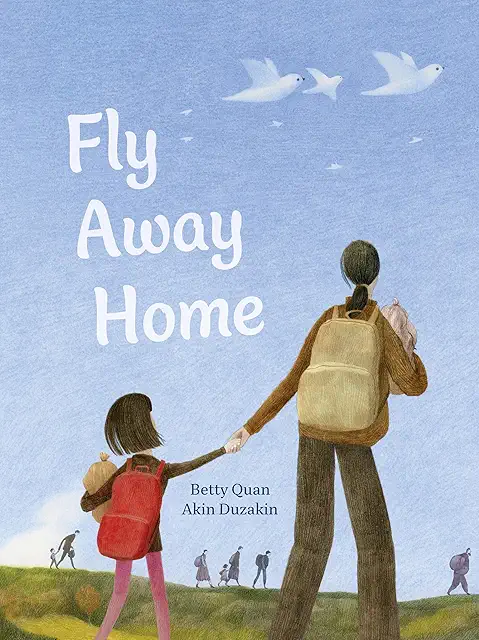
Fly Away Home by Betty Quan, with art by Akin Duzakin is a beautiful multi-leveled picturebook that can be used by readers of all ages. The lyrical text focuses on birds – different birds on each page. While goldfinches leave home, while hummingbirds buzz with news, and magpies cloud the sun the art shows a second story. People walk, in long lines, in small groups. They follow the same paths as the birds, leaving home in search of a new place to live. And where birds allow other species to live amongst them, the people also find homes. We follow a girl and her mother throughout the story. And as they find a new home, so do the birds make new nests. A lovely, subtle story to share with students who have come from many different backgrounds.
ISBN 978-1-77306-962-3, Gorundwood Books
A Time to Choose by Martha Attema is a novel based on an angle of World War II which is not often discussed. We are all familiar with what went on in a room in a house in Amsterdam during German occupation, where people lived in hiding. A Time To Choose is the story of 16 year old Johannes who is Dutch. His movements and life, too, are restricted by the enemy’s rules and regulations. Even though his family lives on a farm, there is not enough food and soldiers can take anything they need for warfare purposes. Johannes’ father is a collaborator with the enemy. How does this effect Johannes and the rest of his family? During the final year of the war, Johannes is old enough to make his own decisions and listen to his own conscience. As he joins the underground resistance, he struggles with what it is right and with his father’s decisions. Johannes faces dangerous situations as he decides to help those who need it. An eye opener for readers of all ages and a story applicable to wars in the world today.
ISBN 1-55143-045-2, Orca Books
Julia and Romano by Eric Walters is a great, contemporary novel for teens. The seed for this book was planted when the author was asked, by a highschool student in a small town on Vancouver Island, what he would write about their town. Walters, not one to shy away from a challenge and always full of ideas for stories, immediately came up with a realistic plot that would appeal to students in this BC town.
Julia has to move with her mom, away from all of her friends, from Toronto to Campbell River in BC. Cody has lived there all of life. Julia becomes good friends with Cody and it isn’t until their friendship blossoms into something more, that the two discover that their parents represent very opposing sites of a picture: a mom who is a lawyer fighting for the environment and a father who owns the local logging company.
This realistic page turner is a true Romeo and Juliet saga. It not only paints a good picture of life in a close knit town, it is also a good story for readers to curl up with.
ISBN 978-1-77086-823-6, BCD Young Readers
Margriet Ruurs is a writer of many awardwinning books for children. She conducts author presentations to International Schools worldwide.
Are your school’s hiring policies unintentionally filtering out your next rising star?
When international schools hunt for new educators or leaders, it is incredibly easy to fall into a hyper-myopic trap. We obsess over specific resumes, exact curricular checkmarks, or even preferred accents.
But in Episode 23 of the Blue Skies Leadership Podcast, Dr. Tim Stuart (Director of Leadership Recruitment at Search Associates) challenges us to look for the “X Factor.”
What is the X Factor? It’s the hidden potential, the upward trajectory, and—most importantly—the deeply human capacity to look at a student or a colleague and say, “I believe in you.”
Tim notes a powerful truth: “I can teach you how to teach IB, PYP, or AP… but I can’t teach you how to be a really good human being who loves collaborating and loves kids. Hire for that.”
Daniel Mendes and I sit down with Tim to dissect how we can build more equitable, diverse, and human-centered pathways for leadership in global education. Listen to E23 – “The X Factor” now
Blooming Flourishing Hibiscus,-water colour by Shwetangna Chakrabarty
At a recent conference on flourishing in the Anthropocene, I found myself sitting with two feelings that are not always easy to hold together: intellectual curiosity as well as deep discomfort.
The conference brought together urgent and necessary questions. What does it mean to flourish in an age where human activity has become a geological force? How might education respond to ecological collapse, climate grief, social fragmentation, and the exhaustion of systems built on extraction? Social, economic, educational, or political systems that survive by taking more than they give back. How do we reimagine education beyond competition, hyper-individualism, marketisation, and the narrow metrics of success that have shaped modern schooling?
These are important questions. They are questions educators cannot afford to avoid.
And yet, as I listened, another question began to form within me: who is being invited to answer them?
Much of the discussion returned, understandably, to colonization. Coloniality was named as a legacy we continue to carry: a way of thinking that separates humans from nature, privileges Western knowledge systems, reduces complexity by categorizing, and positions some people as knowers while others become objects of study. There were calls to disrupt colonial frameworks, to center marginalized voices, to rethink flourishing through relationality, land, community, ecology, and justice.
But as a person shaped by colonized histories, I felt a familiar unease. Too often, the colonized appear in such conversations as evidence, as metaphor, as moral urgency, or as intellectual raw material. Their histories are invoked to critique dominant systems. Their suffering becomes the foundation for reform. Their knowledge is referenced as a solution. But are they present as equal architects of the future being imagined? Isn’t that the urgent need?
This is where my discomfort sat. Is it enough to speak about colonial harm if the people most marked by that harm are not invited or consulted into the centre of the conversation? Is it possible that even well-intentioned reform can reproduce the same hierarchy it claims to resist? Could the message unintentionally become: we colonized you, and now we will teach you how to heal from colonialism?
This question is painful, but necessary. At a systemic level who should lead on this solution-the colonizer or the colonized? Does this feel I am segregating communities into categories, if it does, then I have succeeded in giving you an idea of how I feel sitting through these conversations.
Education has always been deeply implicated in colonial projects. It has classified, ranked, corrected, civilized, assimilated, and erased. It has taught some children to inherit the world and others to doubt their place in it. It has privileged certain languages, literatures, histories, epistemologies, and ways of reasoning, while treating others as local, informal, indigenous, spiritual, emotional, or anecdotal.
So when education now turns toward decolonization, sustainability, relational wellbeing, and the Anthropocene, it must do more than change its vocabulary. It must examine the architecture of participation itself.
Who designs the conversation themes? Who frames the questions? Who is answering these questions? Who leads and who is led? Who is cited as theory? Who is invited as testimony? Who is present in the room, and who appears only in the slides?
The Anthropocene is often described as “the age of man,” a term that captures the unprecedented impact of human activity on the Earth’s systems. But even this framing demands scrutiny. Which humans? Whose activities? Whose industrial revolutions, empires, economies, and appetites? To speak of “humanity” as a single factor risks erasing histories of responsibility. The farmer in India displaced by extractive economies, the Indigenous community in Africa defending land from business giants, the child/ren dying in war zones, and the corporation profiting from extraction and war are not equally responsible for the planetary crisis. Even allegiance makes a difference. Hence I sit in my confusion in these conversations.
At the same time, I wonder whether the Anthropocene should limit us only to the binary of oppressor and oppressed. That binary is necessary for naming injustice, but I strongly think it is not enough for imagining flourishing. If we remain only within the context of harm, colonized vs colonizer, oppressed vs oppressors, we may diagnose the system without learning how to truly live as equals.
I am grateful for the conference that reminded me that flourishing cannot be understood as individual achievement alone. It is relational. It is ecological. It is cultural. It is spiritual. It is linguistic. It is intergenerational. A flourishing student is not merely one who performs well academically, but one who is rooted, connected, purposeful, emotionally alive, critically conscious, and able to imagine futures beyond inherited limits.
But for education to nurture this kind of flourishing, it must resist the temptation to turn relationality into another fashionable framework. Land-based pedagogy, Indigenous knowledge, community epistemologies, photovoice, storytelling, and decolonial thought cannot become decorative additions to an unchanged system. They cannot be extracted from communities, translated into Western academic language, and then re-presented as innovation. That would not be decolonization. It would be epistemic recycling.
The deeper work is not simply to include marginalized knowledge in existing systems, but to ask whether the system itself is capable of being changed by that knowledge. This is particularly important for international education. Our schools often speak the language of global citizenship, intercultural understanding, sustainability, and human flourishing. Yet we must ask whether our curricula genuinely disturbs inherited hierarchies of knowledge, or whether they merely add diversity to a fundamentally Western frame. Do students learn that knowledge lives in many languages, landscapes, bodies, histories, and relationships? Or do they learn that some knowledge is universal while other knowledge is “context”?
Perhaps the real learning from the Anthropocene is not only that humans have damaged the Earth. It is that certain ways of living on this planet have been made dominant at great cost. For me, the most powerful question emerging from the conference was not simply, how do we educate for flourishing in the Anthropocene? It was: who gets to define flourishing, and for whom?
If the answer is still shaped primarily by those historically positioned as the definers of knowledge, then we have not gone far enough. To speak ethically about colonized histories, educators and institutions, the colonized cannot remain the subject of reform. They must be co-creators, critics, theorists, leaders, and designers of the educational futures being imagined.
My understanding through some insightful discussions with colleagues leads me to think that the Anthropocene asks us to confront planetary crisis; decoloniality asks us to confront historical and epistemic injustice; humanistic education asks us to hold onto hope, dignity, and possibility.
The work ahead is not to let the language of decolonization become another performance of institutional virtue, another woke word. It is to create educational spaces where those most affected by colonial histories are not merely remembered, referenced, or researched, but genuinely heard, trusted, and followed. Irony is that we have not even begun to have frameworks for listening, trusting or following, because the solution is always offered not co created. Only then can flourishing become more than a theme. Only then can education begin to repair what it has helped to reproduce. Only then can we ask, with honesty, not just what we learned from the Anthropocene, but what kind of humans we are willing to become first and shape later.
The other day, a parent described himself to me as a “Train Schedule Dad”, a term I was not familiar with. This is someone who manages family trips and daily life with the precision of a railway conductor. This can be added to the different descriptions of parenting in the 21st century that we have become familiar with over time: the snowplow (also called a lawnmower) parent, who endeavors to remove all obstacles from the child’s pathway; the helicopter parent, hovering above their child, checking every move and surveilling their every movement; and the tiger parent, fiercely driven to ensure their child achieves peak academic and extracurricular success.
As such, a strong paradigm of the 21st century is the overinvolved parent who wishes, perhaps understandably, to pave the path for their child, predicting every step, cushioning every blow, and intervening at the drop of a hat. However, how sustainable is this?
In 2019, Eli Lebowitz at the Yale Child Study Center developed the SPACE program, which focused on stopping “family accommodation”—the habit where parents constantly check on or rearrange schedules to soothe an anxious child. By teaching parents how to step back from this over-monitoring cycle, the study showed a dramatic drop in both the children’s anxiety levels and the parents’ own daily stress. It proved that giving children the space to navigate discomfort is often the best way to heal the whole family.
The point is that this study was not only about the child’s anxiety and also about the parent’s anxiety and how it could be reduced. In fact, when parents let go a bit, their anxiety levels go down and so do those of their children. It turns out that overinvolved parenting creates a huge amount of stress for both parties.
As we enter a particularly complex stage of history, with many “known unknowns” ahead and a pressing need to build up resilience and autonomy in young people, parents have to learn the painful but necessary lesson of letting go. This means allowing their children to fend for themselves, to find their own personalities, and to progress without constant intervention from the adults—who should be supporting them from the sidelines, while understanding the necessity of stepping back.
This will become increasingly vital as we enter a world where the ability to stand on one’s own feet and think for oneself will be critical to human flourishing. Letting go is not easy, but it is healthy, necessary, and par for the course.
I finished up my final report this morning, in which I describe the eleven courses I created for myself this past school year, all in the pursuit of learning more about Scandinavia. I proofed it quickly and then wrote at the bottom:
This final report is formally submitted, to myself, on May 21, 2026.
That’s right. I don’t have anyone else to turn it in to, since my role in this degree is student, teacher, dean, and abroad advisor. I’m the procurement guy, I’m the registrar, I’m it, period. I felt a bit like Kamala Harris when, in her role as Senate leader, she announced the flling of paperwork to fill her vacated Senate seat, reading her own name. She had a good chuckle. So too did I, this morning, as I realized that my report was going to nobody else but me.
To celebrate, I took the dog for a walk in the woods on a perfect Swiss spring morning. Dappled leaves, chattering birds, and a dirt path laced with tree roots that wound its way through the woods. The perfect time and place to reflect on what I learned. Below is a little of what I thought about (followed by the course). It’s a mix of content knowledge, pedagogy, and the big and small. The sort of thinking you do on a walk in the woods.
Written Danish, Norwegian, and Swedish are so alike you could call them dialects of Greater Scandinavian. There are probably other languages in the world that are much more distant from each other but that are still called dialects. In fact, linguists like to say that the difference between a dialect and a language is that a language has a navy and an army (language).
Apropos power, power and money is a prevalent theme throughout Scandinavian history, and to generalize, the history of people anywhere, anytime (history).
There are Scandinavian foods I can prepare well and others that I need more practice with. This isn’t the same as saying there are Scandinavian foods I like and Scandinavian foods I dislike, because a few times I think I nailed the recipe but didn’t enjoy the outcome much. Nor some of my family members and friends, just ask them about Flygande Jakob and rømmegrøt (cuisine).
The personality of a language teacher or speaking partner can be tremendously important to the learner. With some tutors I felt almost fluent in Swedish and at least communicative in Danish or Norwegian. With others I was absolutely tongue-tied. Same learner, same year of learning, different outcomes based on my speaking partner (languages).
The lives of Europeans settling in what is now Minnesota in the second half of the 19th century was exceedingly difficult. One walked for miles. One built their own house, starting with trees for the lucky. One hoped not to have a grievous accident during highly dangerous work. One hoped to get to Spring before starving in the Winter. The corollary: My life is extraordinarily cushy compared to all other centuries that humans have existed (Emigration to Minnesota).
As an autodidact, it is easier to maintain your motivation if you share your experience with other people. I don’t think I would have made it without making my project very visible to others (general).
But I did make it, so here’s proof that if you want to pursue an academic subject in depth, and if you don’t need the stamp of approval from an institution, (1) it is entirely possible and (2) it will cost you a fraction of the money (general).
It is the norm for political borders to change, for land to change hands, for the majority of people to be shoved around by the few in power. Not that it makes it right, but it is the story of Denmark and Sweden and the countries around them, expanding and receding, sometimes with breathtaking speed (history).
A good piece of fiction is chock-full of truth (literature).
Supporting adult learning has been a significant contributor to Scandinavian identity for over 150 years. It is something worth investing in no matter our cultural heritage: for individuals, groups, and regions (education).
Whatever I’m able to write down that I learned, I actually learned much more. Intangible things, things gained with growth and maturity that we can’t quite lay our fingers on (general).
While my final report is done, I still have the abroad requirement in front of me, one week each in Denmark and Sweden this coming summer. Then I’ll really be finished, even though I know full well I’ll continue learning language, reading literature, and even baking fresh cinnamon rolls now and again.
I’ve decided I’ll do another year of self-study (in a new subject area), but this time with a group of colleagues who are also taking on self-study of their own. We aim to support each other, to validate each other’s experience, and to serve as soft external motivation for when the internal motivation slips. If you’d like to join us, let me know.
We’d like to think that the professional development we spend time and money on garners this enthusiastic a response much of the time:
“No joke, it’s been life changing for me.”
The fact that it doesn’t is a real problem. The fact that we are often stuck in patterns of telling and explaining, of talking at folks instead of with them, of assuming there’s been learning when there hasn’t been much, that’s a problem.
Professional development does not need to follow old models. Here’s what I experienced this morning, firsthand. An experience of joy, enthusiasm, respect, expertise, and collegiality.
Background
For over a decade, Leysin American School has invited teachers to suggest passion projects that extend across the academic year (and often beyond). Teachers with successful applications receive a stipend and some support from those of us leading professional learning. The actual time we spend on support is minimal. The most significant support is the message that we want teachers to experiment and that their self-directed work is worth doing and sharing.
This morning the faculty had a chance to attend two presentations among the eight that were offered, all led by teachers completing a year of self-directed professional learning. I heard project updates from Andie and Travis.
Outdoor education is education – Andie Flett
We’re about ten people, discussing the value of outdoor education, the why and some of the how. The presenter, Andie, is hitting the exact right tone for teaching adults: friendly, not taking herself too seriously, responsive. This is not a lecture, it is a series of structured discussions on a theme.
This is the third time Andie has been what we call a “resident scholar” since the program began. She and a colleague explored homework support in the resident halls in 2014-2015 and student agency in the activity program in 2020-2021. This current school year she has created a curriculum for an outdoor education class as a regular part of course offerings.
Our group talks about the importance of outdoor education from a variety of angles. Andie asks us, “What if we called our current academic classes ‘Indoor Education’ and we called outdoor education simply ‘Education?’’ The reframing makes us stop and think. What are our priorities? She asks us if it is okay to excuse students from academic classes for outdoor education experiences. Matt, an IB English teacher sitting next to me, says “of course” for his star students. For a struggling student, he hesitates. He names a student who is very focused on the outdoors but not very into Shakespeare. “Actually, who am I to say he should miss an outdoor activity for more Shakespeare, when outdoor activities are his passion, what he is good at?”
Right. In the twenty-five minute session we consider not just outdoor education, but differentiated learning and student choice and whole child development. Andie gets a chance to share her curriculum work with colleagues. We all get to observe an incredible example of non-teacher-fronted instruction. Everyone wins. And Andie knows we care about her and her interests. She matters.
Experimental archeology – Travis Finneran
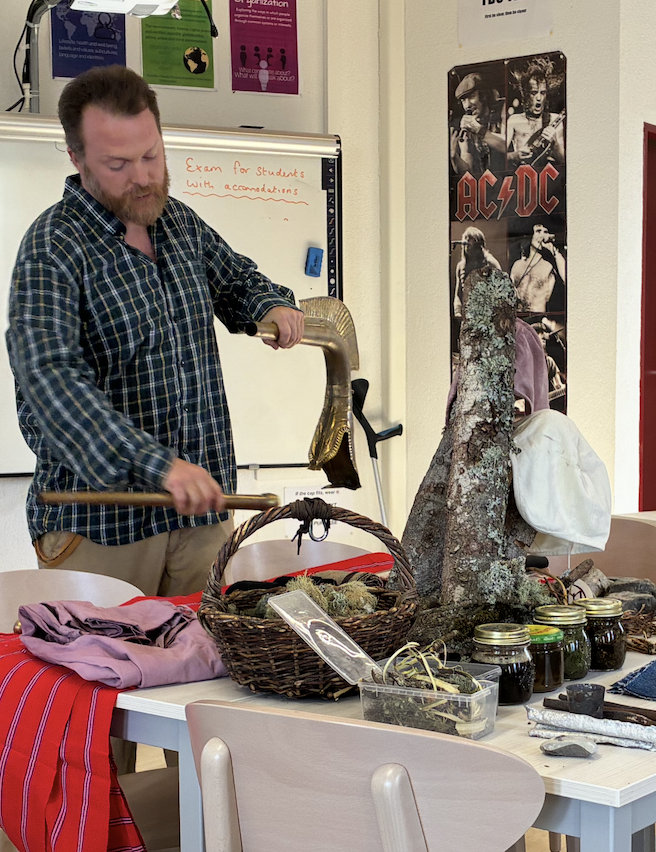
The second session begins with a student playing the carnyx. The carnyx is a long horn, a bit like an alphorn, but the straight metal tube is held vertically, ending in the fanciful head of a dragon. The student can find various pitches, working the mouthpiece with an appropriate carnyx embouchure. Hatty, an English teacher, asks if it took him a long time to learn. “A very long time,” answers Travis, as he thanks the student and starts his presentation.
There are eight of us, sitting in a half circle around a table filled with jars and boxes and cloth and tree branches and rocks. And the carnyx and other stuff I can’t really identify. Travis, who is in his second year of introducing experimental archeology to the school, shares technologies with us from a time when this area of Central Europe was inhabited by the Celts. He talks about how the Romans died clothes, he lifts up bottles of dye made from berries, lichen, and other natural materials. He shows us ingots that he and students have smelted, making sure to share the safety measures he takes as well. He demonstrates how simple cutting tools were made by flintknapping, a process of hitting a stone with a hammerstone at the right angle to create a sharp-edge flint. Lithic reduction, it’s also called.
Travis’ enthusiasm is infectious and we all ask questions and have some good laughs, especially when Travis, who likes to do things as they were done in the past (this is experimental archeology, after all) says that there are limits to sticking with ancient processes. The ammonium he uses, for example, does not come from the source it would have come from back in the middle ages, essentially aging urine.
As teachers file out of the session, past the table of artifacts, Travis tells me he is considering getting a degree in a related field. These past two years of self-directed professional development have been “life changing, no joke.”
The big takeaway
Professional development done right is an amazingly rich and meaningful experience, both for the learning of content and skills and for the sense of professionalism and self-efficacy that comes from sharing one’s continuous growth as an expert in a specific field. Almost universally teachers want to learn and grow and wonder and share with each other. If your professional development program struggles to build teachers up, to engage them, to offer a sense of intellectual wellness, well, build new models that do.
For a list of the teacher-led projects since 2014, see Resident Scholars (www.las.ch/laser)
For more discussion of the promise of highly useful professional learning, see the work of Patrick Alexander (patrickgalexander.org/). We particularly like his conceptualization of “intellectual wellbeing.”
Contact Paul if you’d like to set up a similar program: [email protected].
As summer in the northern hemisphere approaches, I’ve found myself in a number of conversations with parents of teenagers, particularly those who are recent high school graduates or home from college. A few phrases surface again and again: “He doesn’t listen to me anymore,” and “I wish she would get a job.”
They seem to point toward a shift in parenting that is different from the one I grew up with, and one I’ve recently heard described as “permissive parenting.” In this approach, parents often avoid conflict, set fewer boundaries, and sometimes give in to a child’s demands in an effort to maintain peace. Some even suggest that parents feel intimidated by their own children.
This sits in contrast to how things felt more traditional, where what parents said carried real weight. You didn’t really question it. You just accepted it. That was the world I grew up in: babysitting, mowing lawns, shoveling snow, and working forklift jobs in the summer.
What Work Taught Me
Looking back, what stands out most from that early work is not the tasks themselves, but what they required of me.
Above all, I learned how to show up.
There were days that were physically demanding. Heat that scorched, and also frozen days. Early mornings and nights that stretched longer than expected. But within that rhythm, I began to understand initiative. I learned something about discipline, and I began to connect effort with value. In that sense, work was not only about earning money. It was also about learning what it means to contribute. It makes me wonder whether handing a child a credit card, while struggling to say “no,” serves them well for what lies ahead.
The Saturday Morning That Didn’t Match the Story
And yet, things are not always as they first appear.
I was reminded of this recently when a grade 12 student surprised me at 7am on Saturday morning. Wanting to be sure I understood what I was seeing, I later checked her attendance record. On paper, she is what might be described as a “part-time” student, skipping on average a class each day. “Skipping” may not even be the right word,” given that many of these absences are excused by a parent (a topic I’ve written about before in“Breaking the Habit of Excuse”).
And yet, on this particular Saturday morning there she was! Greeting me, taking my coffee order, and working the cash register. Meanwhile, it felt reasonable to assume many of her classmates were still asleep. Curious about this contrast, I learned that her family does not struggle to make ends meet, yet both parents themselves are hard-working. It brought to mind the familiar saying about the apple and the tree. I guess I should not have been surprised.
Learning Through Everyday Responsibility
Another recent moment that is staying with me came during a dinner out. A family, two young parents and their toddler and baby dined at the table next to ours. The toddler did not have the phone of mom or dad in front of him, to hold his attention. He simply watched the room. His younger brother doing nearly the same, except for at one point crumpling a paper placemat in quiet exploration.
When the food arrived, it was not from a children’s menu. The parents cut portions and placed them in front of both children, and then simply allowed them to eat. Meanwhile they carried on their conversation. This “ritual” was not performative, rather seemingly instinctual. There was no coaxing or coddling. If the children were hungry, they would eat. It was beautiful. Unmanaged and natural.
The Lawn, the Robot, and the Missing Lessons
On another day, it seemed my neighbor and I were synched as we moved about mowing and trimming our lawns. At one point we paused in unison and exchanged niceties. I said something in regards to how he soon was likely to be unemployed from lawn duty and how his son would soon take over. He responded how he imagines a robot doing the work. Oddly enough, one of my favorite weekly bloggers, Nathan Krai, recently wrote about a robotic lawn mower. How “it maps the yard. Cuts the grass. Charges itself. Goes back out. No effort. No time required.” The post is titled, “The Trade We’re Not Talking About.” Krai compels us to consider optimization and at what costs. Talking with my neighbor, I couldn’t help but think how getting such a robot would not only be cutting grass. It would be cutting his son out of the opportunity to learn so many things. Responsibility and how regular tasks need to be completed even when they may feel repetitive. Work ethic and a connection between effort and visible results. Delayed gratification or simply the feeling of contributing to the family. And care, maintaining a lawn teaches stewardship and respect for the home. And yet, as Krai alludes to, it may not even be about the “work” but more about optimization and the need for conscious decisions as we move into the possibility of more automated tasks in the futures.
Finding Balance in Parenting and Teaching
Children grow through work, responsibility, and expectations, yet it is also true that an overly permissive approach can limit the kinds of experiences that shape them. At the same time, there is a need for balance. Knowing when to step forward, and when to step back. As a teacher of Capstone, I often feel this as a kind of quiet tension. Part Science, part Art. And yet, not always equal parts.
This year, I experienced that tension with a student I will call Kyle. From the outset, it was clear that a conventional approach would not serve him well. His previous year had been marked by disengagement and avoidance, and his attendance reflected that reality. Instead of insisting on constant structure, I stepped back more than I normally would. Over time, something shifted. Kyle began to build his own project, ultimately learning to vibecode an app that was later published to the Apple Store. It was not a straightforward process. There were misunderstandings along the way, including concerns from some that he was “cheating” by using AI. But what I observed was something different. Kyle’s engagement was sustained and he showcased the value of iteration. His persistence was evident in consistent trial and error. When he presented his work to the community, there was a clear sense of accomplishment. More importantly, there was ownership.
Three Things Worth Holding Onto
As the academic term comes to a close, I find myself returning to three simple reflections:
Teens benefit from summer jobs.
Robots should not be cutting our grass.
And in both parenting and teaching, we are often called to move between stepping forward and stepping back.
And as far as “work” getting a bad name, it seems some cultures, and perhaps classes, have mistaken comfort for success. Avoiding the very effort and discomfort that build capable people.
The EdTech revolution that swept over classrooms some 20 years ago was a wave of uncritical implementation: whiteboards, cloud-based learning platforms, and 1:1 computing programmes unfurled in a tidal wave of widespread technology adoption with each school following the next eagerly.
There were always those anecdotes that threw up questions: was it true that the CEOs of the very same companies selling software and hardware to schools were sending their children to pen-and-paper institutions? Somewhere in the school community, you would find voices that stood up to questions of data privacy, but these were the exceptions that proved the rule. The essential idea was to go with the flow, which is what most schools did, and the intensification of networks, fiber optic cables, chargers, leasing agreements, charging trays, and the maintenance to supply this, proliferated exponentially.
This has led us to a highly synthetic classroom environment: it’s possible to see students learning in an entirely paperless environment. Lessons are projected on a whiteboard and homework is done on cloud computing; we navigate learning from one screen to the next. And at break time and after school? Well, out come more screens of course: phones.
More recently, a different type of wave is rising above classrooms, one that calls for a dialling back on screens. From Anna Lembke’s Dopamine Nation (2021) to Jonathan Haidt’s The Anxious Generation (2024), more and more voices are asking for schools to reconsider technology, in particular phones and screens. There are worrying correlations in the steepening drop of IQ scores (particularly from 2010) and, with the explosion of Artificial Intelligence on the market, the dangers of cognitive offsetting and deficit due to Large Language Models being available to replace research.
At the center of this is the feeling that we need to regain the community connection between us that is now spliced into separate, individual profiles, isolated yet simultaneously hypnotised by chemically stressed layers of carbon polymers, liquid crystals and rare-earth elements. It takes a concerned effort now to pull us away from screens, to shut them down, to appreciate each other rather than whatever’s happening elsewhere in the tiny prism of light held in the hand or propped up on the desk. It’s got to the point where parents of a certain generation are nostalgic about watching television, which is somewhat depressing considering the virtues of the couch potato and how watching TV was viewed as a waste of time by many back in the 1980s.
We’ve reached something of a perfect storm with an increasingly widespread consternation that technology is not actually helping learning but getting in the way of it.
Of course, it’s much more subtle than this: AI tutors, adaptive online assessments, online courses, and the democratisation of knowledge through the internet mean that in many areas, learning has never been this available. It is also true that through COVID-19, and today in certain rural educational programmes, literacy rates have increased dramatically because of technology. It remains a double-edged sword, a two-sided coin, a Pandora’s Box with hope lurking inside it.
As educators, the question we should be asking ourselves today is a simple one: how is our use of technology advancing learning? Rather than giving assignments on cloud computing as a reflex, stop to ask why and whether it wouldn’t be better to ask the students to handwrite in the classroom? Rather than rushing to the next PowerPoint presentation or whiteboard lesson, stop to think whether it might not be better in an analogic setting, through a discussion, without screens. Given what we know about the cognitive benefits of reading and writing, how are we as educators ensuring that these practices remain strong in the classroom?
At the International School of Los Angeles, we have laid out our position starting next year. It’s in four parts:
We will be phone-free right the way through the school.
The 1:1 programme will be staggered, starting in the Middle School with a “computer at school only” policy, then computers at home but with a curfew (we will programme the computers to black out at 21h00). Seniors use computers as before, but we will have scaffolded the way there.
A very specific AI programme on tutoring in one subject using a protected semantic field (not the World Wide Web) carefully curated by a resident specialist with an opt-out possibility for parents. This sits over our school AI policy.
A special course on social media for our students for them to understand the way information is distributed and curated.
We will track this carefully and, most importantly, accompany it by discussions and training with our faculty on how to use technology intentionally, with a sense of genuine innovation, but also trepidation and skepticism.
What will your approach to technology be next academic year?
Works Cited
Haidt, J. (2024). The anxious generation: How the great rewiring of childhood is causing an epidemic of mental illness. Penguin Press.
Lembke, A. (2021). Dopamine nation: Finding balance in the age of indulgence. Dutton.
Sharing stories, expertise, and experiences from international educators around the world. In the spirit of amplifying diverse voices. TIE's blog space is not subject to editorial oversight. TIE bloggers have a long history in various aspects of international education and share their thoughts and insights based on personal experiences.