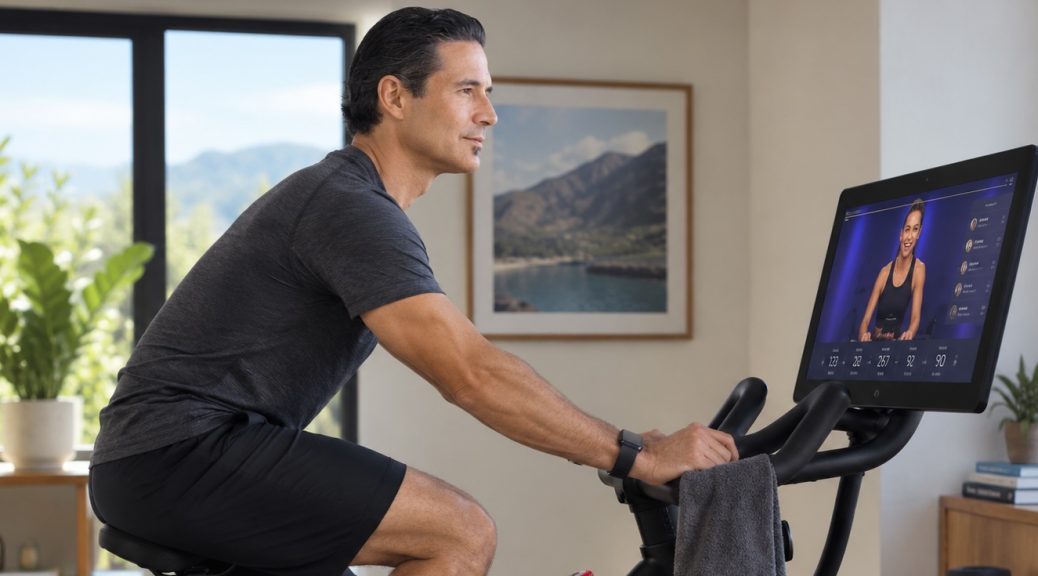
Proud of my punctuality, I find it a little embarrassing to admit that I arrived at the party more than a decade late. The fitness company, Peloton, launched a Kickstarter campaign in 2013 to help fund its first internet-connected stationary bike, which officially shipped to early backers later that year. A cyclist, I likely rode my bike thousands of miles before ever really even knowing anything about Peloton. I faintly remember hearing how the company was a pandemic “darling,” and a few friends had Pelotons. But, if I envisioned the bike in our house, it was likely to be just another place to hang a wet towel. However, everything changed this past summer when my wife ordered a Peloton.
A Beginner Again
Big into being outdoors and having my bicycle roll from point A to B, I would not have believed how I began to feel myself gravitate towards the stationary bike. There was also the notion of having a coach and being challenged by a trainer. In the past, this definitely was not my thing. Though an experienced cyclist, I felt like a beginner again. And there was satisfaction not only in seeing my numbers improve, but by how I began to feel. Admittedly I quickly began to be addicted to Peloton. Now, more than a hundred workouts into the “party,” I think I know why I am a convert. My passion for the bike and all things Peloton Yoga and Stretch, is connected to my desire to learn. Sure, I knew how to ride a bike but a whole new world has seemingly opened. One where exercise and learning synonymously thrive because there is measurability, constant challenge, varied workouts, and personalization. Not to mention convenience and safety.
“Could I begin to replicate this in my classroom?” I began to wonder.
Being a “student” again has resulted in an interest in fitness progress. I am having to do “the work.” Interval training, endurance rides, and a periodic test called a functional Threshold Power test (FTP). This hard 20-minute ride measures the maximum average power you can maintain. Peloton multiplies your 20-minute average output by 95% to set your personalized 7-zone training metrics on the bike. My FTP results are used to establish personalized power zones that guide the intensity of subsequent rides. Instead of guessing how hard to push, I have numbers on the screen to help me gauge my effort. I have a starting point. The work is still mine.
Bringing It Into the Classroom
In the classroom, I find myself planning with greater intention. Opportunities for repetition, feedback, and assessments synonymous to the FTP. Students drafted formal proposals for their senior capstone projects and received feedback. Second drafts were then reviewed by colleagues for another round of feedback, before a final draft was submitted. I also am considering the role of variety in the classroom and changing it up for students. Most recently, energy levels soared after playing a silly game called, “Happy Salmon.” This allows for freshness. Yet, inside and outside the classroom I continue to brush up again what appears to be a greater societal pressure. The desire to know.
Good learning environments give us enough structure to make progress and enough uncertainty to keep growing. Yet, counter to this process approach, there increasingly is a desire to know. To get the answer, any answer. And discomfort with uncertainty appears to be feeding into heightened incidences of anxiety. Not a standalone psychiatric diagnosis, intolerance of uncertainty (IU) is a well-studied psychological trait. I wonder whether our growing access to immediate answers is changing our relationship with uncertainty. A 2026 preprint examining data from 33,864 young adults in U.S. and Canadian college samples reported an increase in intolerance-of-uncertainty scores between 1992 and 2022. The findings do not explain why the scores increased, but they have me thinking about how uncomfortable we seem to have become with not knowing. First it was a fixation on, “What time is it?” A watch attached to our wrist, a clock or three, always within eyeshot. Then, we moved into Googling everything. Now, we find ourselves turning to chatbots to settle questions that, not so long ago, we might have sat with. Or, we may even have shared discourse about. Instead, we are compelled by instant answers. Not to discount the value of chatbots, but I remain curious of what might be happening between our two ears and between us as people. When wonder becomes something to eliminate. There also is the moral question and what it might mean to simply cut out the friction. Are we depriving students of productive struggle? My Peloton workouts certainly do not allow for this!
Stronger Than You Think
Maybe what we need is to recover our willingness to be beginners. To embrace not knowing. This may also be a hidden joy behind my love for Peloton. Aside from the metrics and push for greater performance I am actually enjoying the challenge. The larger question being, how can I improve? Never fully knowing. And not only being okay with this but motivated by it. One of the trainers I keep taking classes from, has a few catchphrases. One is, “You are stronger than you think you are.” I am finding this to be the case. Conceptually it also is surfacing in my teaching. Believing in students more than they likely do themselves. A few years under my belt, I know the greatness which they are capable of. If I might inspire them to believe and then realize this for themselves!
Let Them Decide
Another phrase from this same Peloton trainer is, “I make suggestions, you make decisions.” Teachers are no strangers to decision-making. In an article titled, “Decisions, decisions: Why do teachers feel time poor?” evidence is shared from a 2025 research report involving 138 teachers. 30-minute periods were used as a sample, and the average amount of decisions made in this period fell in the 21–30 range. Prior to this, the daily estimated amount of decisions was 1,500. Could it be that technology is answering more questions? Or maybe more importantly, a technology-rich classroom might reduce the teacher’s need to decide what comes next while increasing the importance of deciding why it matters, whether it is working, and what the student needs as a human being. Regardless, the profession is one wrought by decision-making. I have begun to ask myself which decisions I really need to make for students and which I can return to them. Borrowing my Peloton trainer’s phrase: “I make suggestions, you make decisions,” reminds me that teaching is not about making every choice for students. It is about providing the guidance and conditions that help them make better choices themselves. An 18-year-old asking permission to use the restroom is one small example. Rather than make that decision for the student, I can establish expectations and let the student exercise judgment.
What if we begin to frame uncertainty as opportunity, instead of problem. Then maybe there is more excitement and less anxiety. This “possibility” is what I feel at the start of every workout. A “promise,” of future growth or success, and where the learning begins!
#####################